Total Pageviews

Showing posts with label Ascension. Show all posts

06 June 2011

Of Disciples and Caterpillars


"Lord, is this the time when you will restore the kingdom to Israel?" Clearly, the disciples are stuck in their own small world. Looking backwards, they long for the return of the "good old days", much like some church members demand of us pastors that we bring back the days "when there were hundreds of children in Sunday School".

Jesus responds by re-directing their expectations and expanding their horizons: "It is not for you to know the times or periods that the Father has set by his own authority. But you will receive power when the Holy Spirit has come upon you; and you will be my witnesses in Jerusalem, in all Judea and Samaria, and to the ends of the earth." And with that, he ascends to heaven. 

If Pentecost hadn't happened soon after this, the disciples might have fallen for a fear monger like infamous Mr. Camping (whose doomsday prediction for May 21 didn't pan out). It isn't easy when you are told that looking backwards is not going to help you, and it's harder still when there is no certainty. "It is not for you to know", says Jesus, "but you will receive power when the Holy Spirit has come upon you". When we are told of new horizons and no certainty (at least not the sort we want), we are being called to a journey of faith, but fear will be hovering just around the corner.  "Cast all your anxiety on him, because he cares for you", says the writer of First Peter, but sometimes hanging on to what we know seems so much more comforting.

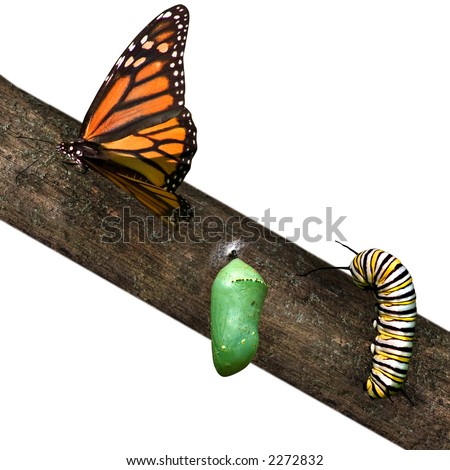
Change is hard. That is the theme of G. Eustace Owen's poem "The Butterfly", in which a beautiful butterfly comes upon a crying caterpillar. Asked what happened to him, the caterpillar wails about being robbed of his brother.


As they talk, the butterfly tells the caterpillar, "It's me, your brother", explaining to the caterpillar that his brother wasn't lost, but has been transformed into a new life. The caterpillar responds with bitter scorn and accuses his butterfly brother of trying to make fun of him.  It's not like the butterfly doesn't try -- much fo the poem is spent with his loving attempt to get through to his brother -- but the poem ends when the butterfly realizes that all the love and care he brings to his brother are to no avail:

The butterfly gave up the struggle. ‘I have,’ he said, ‘no more to say.’
He spread his splendid wings and ascended Into the air and flew away.
And while he fluttered far and wide, The caterpillar sat and cried.

The caterpillar doesn't understand of what his brother talks. He doesn't believe. He prefers to close himself to the possibility of another life.  Seeing his brother ascend into the air, he grumbles that he is too smart to believe in fairy tales.  So it is with the disciples before Jesus yanks them away from their fear, and so it is with many others who have trouble with change.

How can a caterpillar trust a butterfly? The caterpillar only knows his own experience. He lives in a totally different dimension, on a different plane, in a separate reality. How can a caterpillar believe that some day he will fly into the skies? He only knows crawling on the ground. He is encaged in his shell, he knows nothing about his possible wings. He knows nothing about his potentiality.

When Jesus said, "I am the son of God", people became very angry - caterpillars angry at the butterfly; and the caterpillars gathered together, and they killed the butterfly.  Extraordinary courage is necessary to consider that there is something beyond that which we can understand and control, and that this "other" actually can change our lives to the better.  Extraordinary courage is necessary for people to change, for society has fed our egos and our minds so well that we are programmed to stick to what we know.

How about you? Will you shut yourself up because you prefer a safe life in perfect misery?  Or will you consider the possibility that indeed you too could be ascending into a new life?  Will you choose to hang on to what you know, always looking back and wailing about what you have lost?  Or will you let Jesus wake you up?

Fear or Faith, the choice is yours.

Acts 1: 6-14

17 April 2011

When God came way down below ...

There was once a man who set out to find the end of the world. The man was a great philosopher. He was not happy here. Philosophers are never happy here. Now is not their time and here is not their space.


He left his family - children, wife, parents - and went on this crazy mad search to find the end of the world. He passed many mountains, many seas. It was a long journey, naturally, very, very long, and many times he thought he had arrived.


Whenever he started feeling tired he would think he had arrived. Whenever he was feeling exhausted he would deceive himself for a while, but sooner or later, after a great rest, he would start seeing things again and the idea would start persisting again: the end has not come yet, it is still the middle - because he could see further ahead, the horizon was still there, as far away as before. So he would commence his journey again.


On his way he passed many temples and many teachers - people who had arrived, people who thought they had arrived. And they all said and claimed that this was the end of the world. Where was he going? And he would also believe in them and he would stay with them for a time being but sooner or later he would become disillusioned. 

They had not come to the very end themselves, these teachers. And these temples were just again symbols of the tiredness of man, of limitations, of human limitations - limitations of mind and reason and feeling. But the end was not here. And he had to start his pilgrimage again.


And it is said that after a long long long time he finally came to a place that looked like the end. And this time he was not tired and this time he was not exhausted either and this time he was not in any way deceiving himself. Moreover there was no temple and no teacher, he was absolutely alone. And the horizon had suddenly disappeared. There was no further goal.


Even if he had wanted to continue the journey there was nowhere to go. There was a sign saying: 'This is the end of the world'. Someone who had been there before must have put it there out of compassion for those who might dare to come. The man was standing on the very edge of the world - a great cliff beyond which there was nothing but chaos, nothing but nothingness, a tremendous emptiness -- much like the cosmos was in the moment before God created heaven and earth.


And of course he became very frightened. He had not imagined to find chaos - that if you come to the end -- or, for that matter, to the beginning -- you will come to chaos. He had not been thinking of that; it was so unexpected. There was no God, there was no paradise - just chaos, utter chaos, emptiness. You can imagine him standing there on the last cliff, trembling, shaking like a leaf in a strong wind.


He could not take another step. He became so frightened that he escaped back to the world and into the world. He didn't even look at the other side of the sign. The sign board had some other message on the other side. On one side it was written: 'This is the end of the world', and on the other side was written: 'This is the beginning of the other'.


He was frightened, and that's all he knew. So frightened that he forgot that there might be a message on the other side of the sign. He escaped. He didn't look back. He came back to the world and into the world and lost himself into worldly affairs so that he no longer remembered. He banished that dangerous cliff from his dreams, and with it his dream of finding the end of the world.

Jesus, however, took the plunge down that cliff. There was no God, there was no paradise - just chaos, utter chaos, emptiness. "My God, my God, why", he screamed, yet he didn't run back into the world like that philosopher, for he knew that he was in the world, but not of the world.  He took the plunge, and, as our text says,
emptied himself, taking the form of a slave, being born in human likeness. And being found in human form, he humbled himself and became obedient to the point of death-- even death on a cross.
Albrecht Duerer: Ecce Homo 


The act of emptying himself in self-surrender, complete humility and trust -- that amazing plunge is called kenosis by Christians, and sunyata by Buddhists.

Both terms describe someone who leaves his head behind and follows his heart, someone who stops being attached to the things of this world, someone who has given up all desires and attachments, someone who replaces worries with trust, someone who believes that letting go of everything that was will make room for a new beginning.

This strand of Biblical tradition does not show us a Jesus who was an object needed to appease God; it was his free will to plunge into the abyss of ultimate human suffering.  His death on the cross was the ultimate consequence of his obedience, of his authentic life among those way down below who wouldn't back down even when the powers that be threatened his life.

When Jesus took the plunge by putting himself into the deadly machinery of Roman justice, he suffered and died. But God canceled his death. The "Man of Sorrows" dying between two criminals on the shameful cross became the Lord of the Universe, and our text takes us beyond Easter Morning, all the way to the Ascension:

God also highly exalted him and gave him the name that is above every name, so that at the name of Jesus every knee should bend, in heaven and on earth and under the earth, and every tongue should confess that Jesus Christ is Lord, to the glory of God the Father.

Phil. 2, 5-11