Total Pageviews

Showing posts with label trust. Show all posts

01 March 2011

Disordered clocks and an ebony box: Commemorating George Herbert

 George Herbert


 Blest be the God of love,
Who gave me eyes, and light, and power this day,
  Both to be busie, and to play.
  But much more blest be God above,

  Who gave me sight alone,
  Which to himself he did denie :
  For when he sees my waies, I dy :
But I have got his sonne, and he hath none.

  What have I brought thee home
For this thy love? have I discharg’d the debt,
  Which this dayes favour did beget?
  I ranne ; but all I brought, was some.

  Thy diet, care, and cost
  Do end in bubbles, balls of winde ;
  Of winde to thee whom I have crost,
But balls of wilde-fire to my troubled minde.

  Yet still thou goest on,
And now with darknesse closest wearie eyes,
  Saying to man, It doth suffice :
  Henceforth repose ; your work is done.

  Thus in thy Ebony box
  Thou dost inclose us, till the day
  Put our amendment in our way,
And give new wheels to our disorder’d clocks.

  I muse, which shows more love,
The day or night ; that is the gale, this th’ harbour ;
  That is the walk, and this the arbour ;
  Or that the garden, this the grove.

  My God, thou art all love.
  Not one poore minute 'scapes thy breast,
  But brings a favour from above ;
And in this love, more than in bed, I rest.


George Herbert (1593 – 1633), the author of "Evensong" above, was a Welsh born English poet, orator and Anglican priest. He is commemorated by Lutherans on March 1, and is represented by the hymn,"Come, My Way, My Truth, My Life" in most hymnals.

When last week I looked at the poem above, some of the imagery made me grin (our "disordered clocks" that need "new wheels"), but some of it made me cringe as well (namely that ebony box in which, the poet says, we are enclosed by God).

George Herbert pursued government early in life, but then changed course and studied for the ministry.  Much of his poetry was written when he was a priest in a small Anglican parish, where he was adored as a kind and loving shepherd of his sheep.

When on Saturday a friend's husband, Louis, passed away after a futile battle with cancer, all of a sudden some of the phrases that I had dismissed as baroque and dated gained new meaning. "My God, thou art all love. Not one poore minute 'scape thy breast, But brings a favour from above; And in this love, more than in bed, I rest."   

To rest in God's love is what counts -- it keeps our priorities on track and reminds us where home is. Louis has gone home, back to the source of all life, where pain and cancer and tears have no power any more.

"Come, my joy, my love, my heart: Such a joy as none can move;
Such a love as none can part; Such a heart as joys in love."  Amen.

May Louis rest in peace!

24 February 2011

A Cure for Worrying: Commemorating Sr. Elizabeth Fedde

On February 25, Lutherans commemorate Elizabeth Fedde (1850-1921), a Norwegian deaconness who, at age 33, followed her brother's urging to come to New York City. At his request, she took up "the work among the poor and lost Norwegians”, but rather than confining herself to visit the ill and poor in their homes, she found herself working in hospitals, on ships and in the streets.

Three years later she asked the newly founded Norwegian Relief Society to start a deaconness home and hospital. Sr. Elizabeth became well-known, and after enlisting businessmen such as Charles Vanderbilt and John D. Rockefeller, a thirty-bed hospital at Fourth Avenue and 46th Street was dedicated in 1889. Soon the Norwegian Relief Society re-incorporated as the Norwegian Lutheran Deaconesses’ Home and Hospital. Then, in April 1892, the first two deaconesses were consecrated in Brooklyn.

But besides being the "mover and shaker" in ever wider circles, Sr. Elizabeth remained dedicated to her work with the sick and the poor. Even though there was some financial support, she was a pioneer. Lack of sleep, being "on call" at all times and the many sick people she worked with -- all this took its toll on her, and she fell ill more and more frequently.

Her ill health made it necessary for Sr. Elizabeth to return to Norway in 1895, but her work lived on, and mightily so. When in 1956 Lutheran Norwegian Deaconess Home and Hospital merged with Lutheran Hospital of Manhattan, the result was Brooklyn's Lutheran Medical Center, which proudly honors Sr. Elizabeth as its founder.


I could write about Sr. Elizabeth because I am the child of a former deaconness. I could write about her because my first couple of years of chaplaincy training took place at Lutheran Medical Center. Or I could write about her because the first church I attended in the United States was on the very spot where Sr. Elizabeth's first hospital stood: 46th and 4th in Sunset Park. Even though those are all good reasons, today I want to write about her faith and her courage, and especially about her ability to trust God.

This is from Sr. Elizabeth's diary:

March 21: Should stay in and sew but was taken to a poor family; quite young people who have been without work so long that they had no money. Mrs. Børs’s $5 was a welcome gift, even though it brought tears; I asked the woman to come Monday to get clothes for the baby who will arrive shortly; I have nothing now, but because I need it, I believe something will come. March 22: Home for housework, and a woman came with a parcel of children’s clothes and asked if I had use for them. I knew I would have them in time for Monday. At meeting in the evening to get help for the poor... 

"I have nothing now, but because I need it, I believe something will come" -- that's putting into action what Jesus says in Sunday's Gospel: "If God so clothes the grass of the field, which is alive today and tomorrow is thrown into the oven, will he not much more clothe you -- you of little faith."

Sr. Elizabeth is not a woman of little faith, not by far, and somehow people around her begin to have a sense that God's love radiates from her.

Here's what she writes one cold January night:

Out in dreadfully cold weather to a poor family down in a cellar, and after talking to them awhile gave them what I had in my pocket because I thought my purse contained carfare; when I looked, I found nothing and I set out on foot late and in bad weather, but God can soften all hearts. A streetcar driver called and said, “Get on!” I said, “I have no money,” and he cried, “Just come!” That sort of thing has never happened to me before.

Her faithfulness shines especially with those who are skeptical. After describing the cyncial attitude of an unemployed and debilitated young man from Norway, she says, "We stood and talked long together. He stood his ground, but when I said that I prayed God every day that He would send me to those He wanted me to see and that I was sure that God had arranged the meeting with him, tears ran down his cheeks, and they said more than words."

Every so often Sr. Elizabeth admits to be "in a very bad humor". One of those times, she is quite frank in describing the effects of a board meeting on her (some of us have been there and felt similar!): "God be merciful! I have the whole board against me and everything is wrong and I wish I were dead. God be merciful to me, a sinner!"  

Yet some time later, her diary says this: "Tired from the day's work, I sit now and wish I had a thousand mouths and a thousand tongues in each mouth with which to praise God for all goodness to me."

Here is part of Sunday's Gospel in the "Cotton Patch Version" by Clarence Jordan:

So cut out your anxious talk about ‘what are we gonna eat, and what are we gonna drink, and what are we gonna wear.’ For the people of the world go tearing around after all these things. Listen, your spiritual Father is quite aware that you’ve got to have all such stuff. Then set your heart on the God Movement and its kind of life, and all these things will come as a matter of course. 


Sr. Elizabeth had her priorities right. Because her heart was set on God and God's kind of life, "all these things" people worry about, they came to her as a matter of course. She believed and thus she received. She remained in God's love, and God's love radiated out of her for all to see. May her faith embolden ours; may it help us navigate the world in new, more trusting, ways!

When everybody else worries his or her head off, it's our business to stay still. We will receive what we need, without fail.

Matthew 6:25-33

18 February 2011

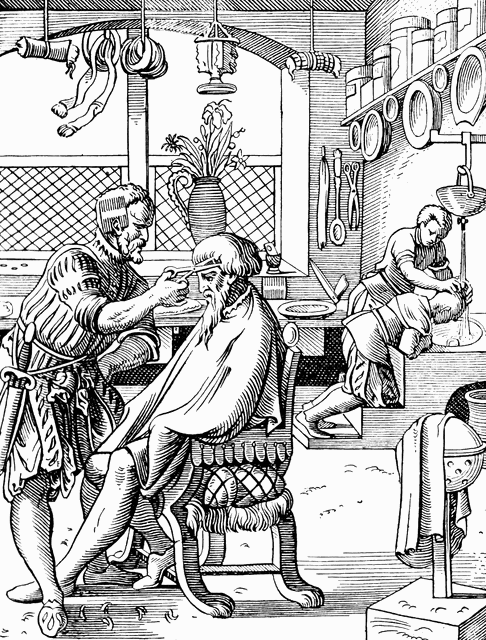
Letter to Peter the Barber, or: Commemorating One Fine Pastor

Today we commemorate Dr. Martin Luther (10 November 1483 – 18 February 1546), reformer, professor, and first-and-foremost a pastor.

This week in our Catechism Class we began reading Luther's open letter to Peter Beskendorf. Peter the Barber was one of Luther’s parishioners, and in his decision to write this letter, we truly see Luther as his caring pastor.  Luther puts himself and his pastoral care right into then context and world of his barber:

A good and attentive barber keeps his thoughts, attention, and eyes on the razor and hair and does not forget how far he has gotten with his shaving or cutting.  If he wants to engage in too much conversation or let his mind wander or look somewhere else he is likely to cut his customer's mouth, nose, or even his throat. Thus if anything is to be done well, it requires the full attention of all one's senses and members. ... How much more does prayer call for concentration and singleness of heart if it is to be a good prayer! 


Carl Trueman of Westminster Theological Seminary in Philadelphia, PA summarizes Luther's Letter to Peter the Barber:

The whole letter is cast as advice to Peter based on Luther’s own practice. When he becomes cold in prayer, he says, he flees to his room to read the Psalms or, if it is the right time, to church to hear the psalms sung and read. He also repeats to himself the Ten Commandments, the Apostles’ Creed, and sayings from Christ, Paul, or the Psalms. He also tries to frame the day with prayer: make it the first business of the day, he advises, and the last thing you do at night. Earthly callings must not be neglected by reason of prayer; but prayer must be the priority. Prayers should not be long and empty babbling; rather they should be structured around the Lord’s Prayer and meditation upon the Ten Commandments ... All this Luther sees as warming the heart and moving us towards prayer that spontaneously cries out to God.

Even though I had thought of it mainly as a fitting conclusion for our class, studying this letter proved to be so much more than that. While our conversations had been intense every week, the conversation felt deeper and more powerful as the church leaders gathered experienced the pastoral care of Pastor Luther. Some asked questions, others marveled, some shed tears and several said, "We didn't know how deep this catechism stuff is". We got through only half of the letter, and decided to add at least another week.

In patiently and simply talking about his own everyday faith, Pastor Luther establishes a climate of comfort and trust, modeling how God wants to be with all of us. Our group was particularly taken with two aspects: Luther's confidence in God's promise and his emphasis on listening to the Spirit of God.

GOD'S PROMISE. When he gets to the end of his discussion of the Lord's Prayer, Luther makes, as always, a big deal of the word "Amen", saying,

Finally mark this, that you must always speak the Amen firmly. Never doubt that God in his mercy will surely hear you and say "yes" to your prayers. Never think that you are kneeling or standing alone, rather think that the whole of Christendom, all devout Christians, are standing there beside you, and you are standing among them, in a common, united petition which God cannot disdain. Do not leave your prayer without having said or thought, "Very well, God has heard my prayer; this I know as a certainty and a truth." This is what Amen means.

These words don't just convey Luther's trust in God, but shows the almost childlike intimacy of his relationship with God. It's like he is saying, "I know when I ask something of my Daddy, it's as good as done, so I won't worry about it. He's there for me. I am his child; he is my Daddy.  That settles it."

LISTENING TO THE SPIRIT. In the same section, Luther talks about how prayer (when it is nothing but mindless repetition) can become "idle chatter and prattle". Almost like that of a modern therapist, his advice is greater creativity and flexibility: "... It may happen occasionally that I may get lost among so many ideas in one petition that I forego the other six", but the flexibility is necessity for more than just a more relaxed disposition:

If such an abundance of good thoughts comes to us we ought to disregard the other petitions, make room for such thoughts, listen in silence and under no circumstances obstruct them. The Holy Spirit himself preaches here, and one word of his sermon is far better than a thousand of our prayers. Many times I have learned more from one prayer than I might have learned from much reading and speculation.

"The Holy Spirit himself preaches here".  In this passage we encounter Luther as the mystic he was, an aspect of our Reformer that oftentimes gets lost (even though it can be found in some of his hymns), emphasizing that rather than accumulating more and more knowledge, the People of God should allow themselves to get close to the source of all knowledge, the Holy Spirit.

The Spirit of God comes in silence and in deep contemplation, when the praying person is truly emptying himself or herself of all "reading and speculation", and makes room for the "sermon". It has been said that a mystic is someone who "melts into God" -- true intimacy indeed.

O God, our refuge and our strength: You raised up your servant Martin Luther to reform and renew your Church in the light of your word. Defend and purify the Church in our own day and grant that, through faith, we may boldly proclaim the riches of your grace which you have made known in Jesus Christ our Savior, who with you and the Holy Spirit, lives and reigns, one God, now and for ever. Amen.