Total Pageviews

Showing posts with label Martin Luther. Show all posts

20 May 2011

The Power of Metaphors II (Doomsday Prophecies)

We might overlook it when seminarians don't "get" metaphors (see my last post), but what if a grown man doesn't get it and tries to tease literal meanings out of a metaphor? The metaphor in question is found in Second Peter, a verse echoing Psalm 90:

But, beloved, be not ignorant of this one thing, that one day [is] with the Lord as a thousand years, and a thousand years as one day. 

Instead of enjoying the beautiful metaphor, an 89 year old prophet of doom named Harold Camping began a set of complicated calculations, and when he was done, he predicted that the end of the world will be here on May 21, 2011 at 6pm.

I know of at least one person who, when learning about Mr. Camping's predictions, withdrew all his funds and took off for parts unknown. But let's see ... other such predictions were made for 1844, 1914, 1918, 1925, 1942, 1981, 1983, 1988, 1989, 1992, 1993, 1994, 2012 and 2060.  Last time I checked, we and our messy beloved world are still here.


When at mid-day May 19, 1780 an inky darkness descended on Connecticut, so dark that birds retired to their nests and residents lit candles, citizens reached for an explanation in the source they knew best, the Bible. Now understood to have been a perfect storm of smoke and cloud cover, back then many people were convinced that it had to be Judgment Day. The countryside experienced a bit of a panic – save for one Connecticut legislator, Abraham Davenport, a Stamford legislator who said that if Jesus was coming, he preferred to be found working. Davenport asked for candles, and the Senate kept working through the gloom.

Martin Luther is reported to have said, "Even if I knew that tomorrow the world would go to pieces, I would still plant my apple tree".

- It's time to realize that doomsday predictions are nothing new under the sun.
- It's time to remember that talk about the "rapture" is not Biblical, and that millenialists and their calculations belong into the fiction section of your local bookstore.
- It's time to remember that Jesus said that not even he was privy to the date and time of the end.

The opposite of faith is fear, and fear-mongers always make money simply because people long for some measure of certainty.  Not only did Mr. Camping "earn" about 100 Million Dollars, he frightened a few drifting souls very badly: think of the mother who tried to slit her children's throats with a boxcutter, and the folks who said they were going to euthanize their pets before that 6pm deadline.

As the children of God, we have nothing to fear; uncertainty is part of life. With Martin Luther and Abraham Davenport, I intend to relax.  I will look forward to a beautiful new day, a day full of adventures, a day full of chances to meet God on the road.

2 Peter 3:8

27 March 2011

Led to Those at the Margins ...

When in our DIAKONIA class tonight we were talking about Luther's Theology Of The Cross, we spoke about how as People of the Cross we always are led to those who have been pushed to the margins by those who have the power. It was delightful to see how the students who only last week had bitterly complained about the "heavy" reading (Douglas John Hall), began to "get it".

As inspiration blew away their moans and groans, lights came on and wheels turned. The students "thought out loud", discovering that indeed we are setting ourselves apart when we communicate the Good News to those who are oppressed -- for the mighty ones know deep down that not power but love will win in the end.

Our Gospel lesson about the Woman at the Well illustrates this movement toward the ones who have become victims: Jesus appeals to the woman's hospitality, yet this is not supposed to happen. For the unnamed Samaritan woman, Jesus belongs to those who have made outcasts of the Samaritans in the first place; to her great surprise, here is one of the oppressors asking her, the oppressed, for assistance in his need. He is thirsty, and he is asking her for a drink.

The woman, outcast as she is, aligns herself with the corporate outcast identity of her country. In relation to an “oppressor” from the “establishment" (Jerusalem) she becomes one with the very people who reject her and mistreat her. She is a victim within her culture, and victims usually have no alternative to the rejecting culture for their cultural identity, and so it is that the Woman at the Well professes solidarity with her fellow Samaritans.

When he asks the woman to go and bring her husband, Jesus lays bare the woman’s place in her community as the communal scapegoat. Five men have married and divorced this woman and one other man has entered into a relationship with her. When we consider that it is likely that each former husband has married somebody else, implicating the whole family of each of these women, we begin to see that what Jesus is doing: he uncovers the way life at Sychar is organized around scandal.

This woman has received all of the blame for the divorces and her current tenuous status, and apparently, none of the blame has gone to any of the men. In a small town, this means that a significant part of the population is connected with this scandal. No wonder the woman has to absorb all of the blame!

Salvador Dali:  Da mihi bibere 

It dawns on the Woman at the Well that Jesus, just by talking to her, is changing her social position. He is unveiling the scapegoating mechanism of the town and undermines the fact that this community is organized around scapegoating.

"I am he, the one who is speaking to you." As Jesus says these words in Aramaic, he reminds everyone who knows Scripture of the first “I am” saying in the Bible; it was spoken by God to Moses when God appeared to him in the burning bush, and revealed his name, YHWH.

Now, Jesus speaks the first of the “I am” sayings recorded in the Gospel of John, and he speaks it to an outcast, a nameless Samaritan woman. Knowing the connection with the Old Testament reference, what sounds so innocent in our translation, "I am he, the one who is speaking to you”, means a whole lot more; a better translation would be: “I am God himself, here and now; I have always been, I will always be.”

By telling the woman who she is, Jesus shows her who he is. By confirming her true identity, he reveals his own, and that is how it still happens in any intimate relationship. In her relationship with Jesus, the Woman at the Well has a powerful epiphany and becomes an enlightened believer. She has received life-giving water. By the end of the conversation, she has the clarity that comes with true faith. She knows what she really needs, and she has found it.

Knowing in her heart that true life is just beginning, she is full of joy. She rethinks who she is. She learns to take all power away from those who have made her the scapegoat of the town. The people of Sychar come to believe in Jesus. Far from driving him away, they invite him to stay, and many more come to believe “because of his word.” What Jesus has done is gather the whole town of Sychar around the well.

The Woman at the Well is no longer the victim at the center of the society; she is at the edge around the well with everybody else in town. The center is now Jesus. The Samaritans have accepted the truth of what they were doing socially in their own town and have moved to the level of worshiping in spirit and truth; in the process, they are freeing themselves from their scapegoat status in relationship to the Jerusalem establishment.

By telling this story, John has given us a vision of God’s kingdom. The Woman at the Well represents the workings of God's kingdom in the midst of human failings. Her story shows us not only where to find that "living water": It also helps us to become sensitive to all the scapegoating around us, and how communicating the gospel and challenging oppression go hand in hand.

In the end, not power will win, but love. As we learn to embody love the way Jesus did, we realize that a triumphalist church is a church of the past; we are called to be the servant church. In proclaiming the Crucified God, we will be a light to the nations!

John 4: 5-29

13 March 2011

Demonizing Muslims

40% of all extremist plots in America were thwarted as a result of Muslim American help. The majority of terror plots in America since 9/11 has been committed by non-Muslims, especially right wing extremists and white supremacists. Muslim American terrorism and involvement in extremism has significantly decreased.

Yet Congressman King stubbornly insists that Muslims have not cooperated with law enforcement -- after the tune, why let the facts get in the way if I can hold on to my opinion.  Mr. King has convinced others that a congressional hearing must be held under the bombastic title, "Extent of Radicalization in the American Muslim Community and that Community's Response".  Something about this picture is very wrong!

As Lutherans we know how much Martin Luther agitated against certainty in most matters.  To be sure, Luther was certain of his faith; however, everything beyond that was for him a world in the process of becoming. He consistently warned against those who thought they had it all together, knowing full well that there are no such people.

Fellow preacher Barbara Brown Taylor comes to mind, in her interpretation of Nicholas of Cusa, one of Luther's spiritual forerunners. She says:

In Nicholas's scheme, the dumbest people in the world are those who think they know. Their certainty about what is true not only pits them against each other; it also prevents them from learning anything new. This is truly dangerous knowledge.  They do not know that they do not know, and their unlearned ignorance keeps them in the dark about most things that matter.

It's not for nothing that in old maps the edges, known as terra incognita (unexplored and thus unknown territories), were marked with the words "here be dragons".


Absolute certainty sells -- as one of my teachers used to say, "it's always cheaper to stay unconscious" -- but it's unrealistic.  Real life doesn't work that way; it's riddled with doubt and uncertainty and pain and suffering and blunders over blunders.

Luther laughed at those who tried to erase uncertainty and doubt and replace them with certainty and absolute faith -- against those triumphalists he held up the Cross of Christ in all its messiness.

Singling out one particular group -- in this case Muslims -- is always born of fear and self-righteousness, and always wrong, for there is no "other".

Singling out one particular group denies the fact that we are all made of the same fabric, one human family: no matter what we look like, no matter where we come from, where we live, what we believe, how we vote, who we call our friends -- we are one, and each of us has been made to represent our creator.  Divisions are all about power and the fear of losing control.  Divisions are selfish and greedy.

The only way to heal divisions is love -- which, as St. Paul writes, "is patient and kind; ... not jealous or boastful; ... not arrogant or rude. Love does not insist on its own way; ... is not irritable or resentful;  ... does not rejoice at wrong, but rejoices in the right. Love bears all things, believes all things, hopes all things, endures all things. Love never ends".

1 Corinthians 13:1-13

18 February 2011

Letter to Peter the Barber, or: Commemorating One Fine Pastor

Today we commemorate Dr. Martin Luther (10 November 1483 – 18 February 1546), reformer, professor, and first-and-foremost a pastor.

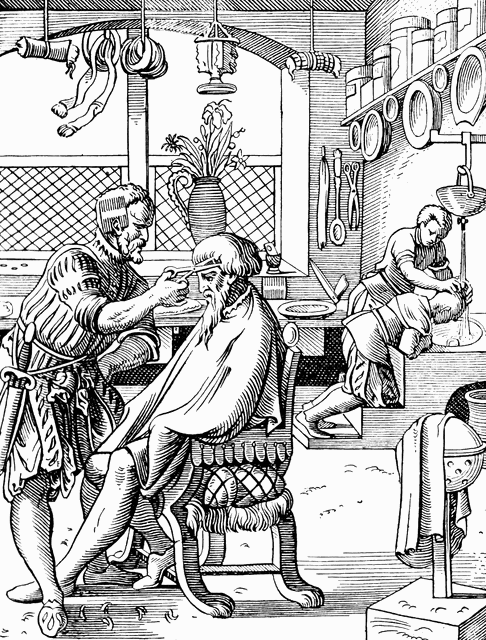
This week in our Catechism Class we began reading Luther's open letter to Peter Beskendorf. Peter the Barber was one of Luther’s parishioners, and in his decision to write this letter, we truly see Luther as his caring pastor.  Luther puts himself and his pastoral care right into then context and world of his barber:

A good and attentive barber keeps his thoughts, attention, and eyes on the razor and hair and does not forget how far he has gotten with his shaving or cutting.  If he wants to engage in too much conversation or let his mind wander or look somewhere else he is likely to cut his customer's mouth, nose, or even his throat. Thus if anything is to be done well, it requires the full attention of all one's senses and members. ... How much more does prayer call for concentration and singleness of heart if it is to be a good prayer! 


Carl Trueman of Westminster Theological Seminary in Philadelphia, PA summarizes Luther's Letter to Peter the Barber:

The whole letter is cast as advice to Peter based on Luther’s own practice. When he becomes cold in prayer, he says, he flees to his room to read the Psalms or, if it is the right time, to church to hear the psalms sung and read. He also repeats to himself the Ten Commandments, the Apostles’ Creed, and sayings from Christ, Paul, or the Psalms. He also tries to frame the day with prayer: make it the first business of the day, he advises, and the last thing you do at night. Earthly callings must not be neglected by reason of prayer; but prayer must be the priority. Prayers should not be long and empty babbling; rather they should be structured around the Lord’s Prayer and meditation upon the Ten Commandments ... All this Luther sees as warming the heart and moving us towards prayer that spontaneously cries out to God.

Even though I had thought of it mainly as a fitting conclusion for our class, studying this letter proved to be so much more than that. While our conversations had been intense every week, the conversation felt deeper and more powerful as the church leaders gathered experienced the pastoral care of Pastor Luther. Some asked questions, others marveled, some shed tears and several said, "We didn't know how deep this catechism stuff is". We got through only half of the letter, and decided to add at least another week.

In patiently and simply talking about his own everyday faith, Pastor Luther establishes a climate of comfort and trust, modeling how God wants to be with all of us. Our group was particularly taken with two aspects: Luther's confidence in God's promise and his emphasis on listening to the Spirit of God.

GOD'S PROMISE. When he gets to the end of his discussion of the Lord's Prayer, Luther makes, as always, a big deal of the word "Amen", saying,

Finally mark this, that you must always speak the Amen firmly. Never doubt that God in his mercy will surely hear you and say "yes" to your prayers. Never think that you are kneeling or standing alone, rather think that the whole of Christendom, all devout Christians, are standing there beside you, and you are standing among them, in a common, united petition which God cannot disdain. Do not leave your prayer without having said or thought, "Very well, God has heard my prayer; this I know as a certainty and a truth." This is what Amen means.

These words don't just convey Luther's trust in God, but shows the almost childlike intimacy of his relationship with God. It's like he is saying, "I know when I ask something of my Daddy, it's as good as done, so I won't worry about it. He's there for me. I am his child; he is my Daddy.  That settles it."

LISTENING TO THE SPIRIT. In the same section, Luther talks about how prayer (when it is nothing but mindless repetition) can become "idle chatter and prattle". Almost like that of a modern therapist, his advice is greater creativity and flexibility: "... It may happen occasionally that I may get lost among so many ideas in one petition that I forego the other six", but the flexibility is necessity for more than just a more relaxed disposition:

If such an abundance of good thoughts comes to us we ought to disregard the other petitions, make room for such thoughts, listen in silence and under no circumstances obstruct them. The Holy Spirit himself preaches here, and one word of his sermon is far better than a thousand of our prayers. Many times I have learned more from one prayer than I might have learned from much reading and speculation.

"The Holy Spirit himself preaches here".  In this passage we encounter Luther as the mystic he was, an aspect of our Reformer that oftentimes gets lost (even though it can be found in some of his hymns), emphasizing that rather than accumulating more and more knowledge, the People of God should allow themselves to get close to the source of all knowledge, the Holy Spirit.

The Spirit of God comes in silence and in deep contemplation, when the praying person is truly emptying himself or herself of all "reading and speculation", and makes room for the "sermon". It has been said that a mystic is someone who "melts into God" -- true intimacy indeed.

O God, our refuge and our strength: You raised up your servant Martin Luther to reform and renew your Church in the light of your word. Defend and purify the Church in our own day and grant that, through faith, we may boldly proclaim the riches of your grace which you have made known in Jesus Christ our Savior, who with you and the Holy Spirit, lives and reigns, one God, now and for ever. Amen.

09 January 2011

Baptism as a Way of Life: Musings on metaphors in Luther's teaching.

In our catechism class last Wednesday we talked about the powerful metaphors Martin Luther uses to indicate just how central baptism is for all of his theology. We mentioned three (the blackboard, the dog's house, and butter), and today I discovered another one, as I was reading an Epiphany sermon he preached on January 6, 1534.

THE BLACKBOARD is what Luther used when he felt under attack by the devil. He would write on that blackboard three words: ICH BIN GETAUFT, German for "I have been baptized", and as he kept looking at the words, he would find peace for his soul.

THE DOG'S HOUSE -- very unlike what Americans associate with "being in the dog house" -- stands for the protection Luther felt his baptism provided. It was the place to which he returned when he was out of sorts, spiritually and otherwise. "I crawl into it," he said, and then felt completely safe, reminded that even though he would fail again and again, the promise of salvation (embodied in baptism) would not.

BUTTER stands for how little Luther trusted faith without the tangible "signs" that were connected with it and grounded it: water, bread and wine. "Faith alone", he said, "is butter in the sun", because human beings are prone to fall for all sorts of seductive forces, unless they have something to hold on to that reminds them why their faith makes sense and is grounded in God's promise.


AQUAVIT. The metaphor I just discovered is that of Aquavit. In his Epiphany sermon, Luther makes fun of those theologians who think of baptism as "just water":  

"To be sure baptism is water. But today some are saying it is 'plain water'. ... My dog Tölpel (German for "blockhead"), a wild boar, and a cow know that. But what else is here? Without doubt, in baptism we get God-Father, Son, and Holy Spirit -- and all the angels! ... The Father, the Son, and the Holy Spirit are in the water; it is the bath water of Christ, the presence of the Holy Spirit, the preaching of the Father. This makes it water that takes away sin, death, and every sadness, and helps a person into heaven. Water becomes a precious ointment and medication because God has stirred himself into it. The Father can bring a person to life, and he is in this water. That’s why it is the genuine Aquavit."  (Epiphany Sermon)

Long before the vodka companies rediscovered the word -- even in Luther's day -- Aquavit was a common term for distilled spirits. Luther revitalized baptism as a sacrament by not treating it like "something that happened a long time ago", but as a way of life; thus, his image of drowning Old Adam daily, so that a rejuvenated person would go forth into each new day.

"To put it most simply, the power, effect, benefit, fruit and purpose of baptism is to save. ... To be saved, we know, is nothing else than to be delivered from sin, death, and the devil and to enter into the kingdom of Christ and live with him forever."  (Large Catechism)

Matthew 3:1-18