Total Pageviews

Showing posts with label cross of Christ. Show all posts

13 March 2011

Demonizing Muslims

40% of all extremist plots in America were thwarted as a result of Muslim American help. The majority of terror plots in America since 9/11 has been committed by non-Muslims, especially right wing extremists and white supremacists. Muslim American terrorism and involvement in extremism has significantly decreased.

Yet Congressman King stubbornly insists that Muslims have not cooperated with law enforcement -- after the tune, why let the facts get in the way if I can hold on to my opinion.  Mr. King has convinced others that a congressional hearing must be held under the bombastic title, "Extent of Radicalization in the American Muslim Community and that Community's Response".  Something about this picture is very wrong!

As Lutherans we know how much Martin Luther agitated against certainty in most matters.  To be sure, Luther was certain of his faith; however, everything beyond that was for him a world in the process of becoming. He consistently warned against those who thought they had it all together, knowing full well that there are no such people.

Fellow preacher Barbara Brown Taylor comes to mind, in her interpretation of Nicholas of Cusa, one of Luther's spiritual forerunners. She says:

In Nicholas's scheme, the dumbest people in the world are those who think they know. Their certainty about what is true not only pits them against each other; it also prevents them from learning anything new. This is truly dangerous knowledge.  They do not know that they do not know, and their unlearned ignorance keeps them in the dark about most things that matter.

It's not for nothing that in old maps the edges, known as terra incognita (unexplored and thus unknown territories), were marked with the words "here be dragons".


Absolute certainty sells -- as one of my teachers used to say, "it's always cheaper to stay unconscious" -- but it's unrealistic.  Real life doesn't work that way; it's riddled with doubt and uncertainty and pain and suffering and blunders over blunders.

Luther laughed at those who tried to erase uncertainty and doubt and replace them with certainty and absolute faith -- against those triumphalists he held up the Cross of Christ in all its messiness.

Singling out one particular group -- in this case Muslims -- is always born of fear and self-righteousness, and always wrong, for there is no "other".

Singling out one particular group denies the fact that we are all made of the same fabric, one human family: no matter what we look like, no matter where we come from, where we live, what we believe, how we vote, who we call our friends -- we are one, and each of us has been made to represent our creator.  Divisions are all about power and the fear of losing control.  Divisions are selfish and greedy.

The only way to heal divisions is love -- which, as St. Paul writes, "is patient and kind; ... not jealous or boastful; ... not arrogant or rude. Love does not insist on its own way; ... is not irritable or resentful;  ... does not rejoice at wrong, but rejoices in the right. Love bears all things, believes all things, hopes all things, endures all things. Love never ends".

1 Corinthians 13:1-13

30 January 2011

Being the "Poor in Spirit": Being God's Fools

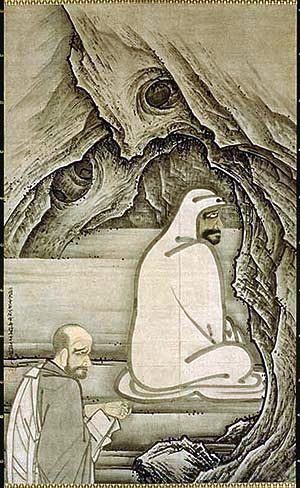
Bodhidharma was a Buddhist monk who lived during the 5th/6th century and is traditionally credited as the transmitter of Zen from India to China.  After he had arrived in China, for nine years he remained in a cave, meditating while facing the wall. Many came to persuade him to come out, ”Why don’t you talk to us? We ask questions and you give answers to the wall. It makes us uncomfortable.” But Bodhidharma said, ”Unless the man comes who has the ears and the heart to understand me, it is better to talk to the wall. At least no one is disappointed.” And then, one day the man came.

This man was a young man named Eka, who had traveled across the high mountains of eastern China in the cold of December. Eka was standing in waist deep snow outside of Bodhidharma's cave, cold tears freezing as they were running down his face. Inside the cave, Bodhidharma was in deep meditation.  

As he waited outside, despite the hardship, despite the suffering, Eka began looking within himself and began to let go off all aspirations and attachments. He simply waited outside for Bodhidharma to recognize him, not for his own sake or for any gain, but because he knew it was right somehow. But Bodhidharma ignored Eka, and stayed inside. Eka strengthened his resolve; he let go of all ambitions and all his ego attachments. 

Finally, at dawn, when the long cold night finally ended, the teacher emerged from the cave, seeing that his new student had indeed progressed quite nicely. Bodhidharma took pity on Eka and asked,“What are you after, standing there in the snow for such a long time?” Eka's tears of sorrow were falling even more profusely as he answered, “I simply ask that you have compassion on me and open the gate to what I long to learn.” 

Bodhidharma said, “That gate can only be opened for those who ceaselessly practice what is hard to practice and who ceaselessly endure what seems beyond endurance. But be warned, if you still rely upon a frivolous heart or on a prideful and conceited mind, you will toil in vain.” 

Eka was encouraged by Bodhidharma's words, but he knew he had to make one more demonstration to prove his worthiness to the Master. So Eka secretly took out a very sharp sword and with one quick stroke, cut off his left forearm. He took his left arm and threw it before Bodhidharma and said, ”If you don’t turn immediately towards me, I am going to cut off my head too.” 


Bodhidharma quickly turned, and said, ”So you have come! I have been waiting for nine years.” Bodhidharma added, "In their seeking the Way, all the masters, from the first, have laid down their own bodies for the sake of the Way. Now you have cut yourself free right before me, which is proof that there is good in what you are seeking.”

For the next eight years, Eka served as attendant to the Master in all his endeavors. He was a great, reliable spiritual friend for both ordinary people as well as for those in loftier positions, and he was a great teacher of the Way. And when the time came, Bodhidharma chose him as his successor.

Eka was inspired by Bodhidharma's words to arouse wisdom and finally cut himself free from any last vestiges of clinging and grasping, represented by his left forearm, and he then presented himself and his understanding to Bodhidharma for approval. The ancient masters maintain that when Eka cut off his arm, there was no effort involved; he was so relaxed, so trustful. He was relaxed and trusting because he had learned to let go. His ego was firmly in check.

The story of Bodhidharma and Eka is about letting go – and so is Jesus' First Beatitude (in today's Gospel text from Matthew 5):

Blessed are the poor in spirit, for theirs is the kingdom of heaven. (Matthew 5:3)

When Johannes Jessen translated that sentence into the Lower German dialect of my home in Northern Germany, he rendered it this way:

Selig sünd de Minschen, de as beddelarme Lüd vör Godd sin Dör kamt un weet, dat se vör em niks uptowiesen hebbt -- ehr hört dat Himmelriek to!  (In plain English: Blessed are those who come to God's door as people who are dirt poor and know they have nothing to show for themselves -- the Kingdom of Heaven is theirs.)

German mystic Meister Eckhart offers this interpretation: “A poor man is one who wants nothing, knows nothing and has nothing.”

  • Eckhart says we need to be “poor of will”, by wanting just as little now as when we were too small and immature to have our current desires. 
  • Eckhart says we need to be “poor of knowledge”, by freeing ourselves from all the knowledge that has been stuffed into us, and by realizing that such knowledge only ties us to this street theater called "the world". 
  • Eckhart says we need to be “poor of having”, by freeing ourselves of all desire to control things with the things we own or cling to. He traces this thought even into our image of God, saying, “I pray to God to make me free of my ideas of God.” If we have ideas of God, we still retain control, and as truly detached believers we must surrender all control.
When we truly are in that place where we want nothing, know nothing and have nothing, we will be free and blessed as on our first day on this planet.

How can we achieve such freedom? Echoing the warning Bodhidharma had for his young student ("If you rely upon a frivolous heart or on a prideful and conceited mind, you will toil in vain"), Eckhart tells us to start the process of putting our ego in check in a very simple manner: “Take a look at yourself, and wherever you find yourself, deny yourself. That is best of all.”

Martin Luther, a theological giant of great fame and vast influence, said these words on his death bed: “We are beggars – this is true.” That's being “poor in the spirit” -- knowing that we come to God as people who have nothing to show for ourselves. And there's nothing wrong with that -- in fact, it's the only way to be right, for "without poverty of spirit, there can be no abundance of God" (Oscar Romero, martyred Archbishop of El Salvador).

What is the result of such freedom? In embodying "a true spirit of poverty which makes the rich feel that they are closer brothers and sisters of the poor, and makes the poor feel that they are equal givers and not inferior" (Oscar Romero), the People of God find themselves in an acute clash with the values of the world, exposing themselves as foolish misfits and outcasts, as "God's fools".  Paul is very sober and clear-eyed when he says:

For the message about the cross is foolishness to those who are perishing, but to us who are being saved it is the power of God. For it is written, "I will destroy the wisdom of the wise, and the discernment of the discerning I will thwart." Where is the one who is wise? Where is the scribe? Where is the debater of this age? Has not God made foolish the wisdom of the world? For since, in the wisdom of God, the world did not know God through wisdom, God decided, through the foolishness of our proclamation, to save those who believe. 

As people who live by the Wisdom of God rather than under the Wisdom of the World, we know that our values do not conform to those of competition and domination that are propagated by the world around us. As the People of God we are truly "countercultural". Our culture teaches us to be selfish, but the cross beckons us to have compassion. Our culture condemns the poor and homeless and blames them for their misfortune, but the cross beckons us to embrace them as sisters and brothers. Our culture teaches us to look down on those who have less, but the cross beckons us to feed them.

Being countercultural carries the very real risk of suffering and the cross, but the rewards are manifold, and far from just otherworldly: as the People of God we can tap into what Rabbi Michael Lerner calls the "irrepressible elements of human nature" shared by all humanity; in his recent article on the "State of the Spirit", Lerner says:

Human beings share a deep yearning to live in communities that provide a sense of purpose to their lives. Yearning to transcend the narrow visions of material self-interest, we long to connect to something of abiding value. We share a hard-wired empathy and love for others, as well as a deep need to be recognized, understood and loved not for what we can do or deliver for others, but for our own intrinsic worth (what the Torah calls being created in the image of God). And we have an irrepressible instinct to seek freedom; creativity; artistic expression; higher and higher levels of understanding and consciousness; love and caring for others; the creation and enjoyment of beauty and pleasure; and both joyous celebration of and awe-filled responses to all the wonders of life in this universe.  

Matthew 5:3; 1 Corinthians 1:18-31

15 January 2011

The Arizona Shooting and the Myth of the Sacred Scapegoat

There are no coincidences. The universe saw it fit for us to get a taste of home-grown violence, a week before we hear John's assessment of Jesus, "Here is the Lamb of God who takes away the sin of the world!" (John 1:29), and eight days before we commemorate the birthday of Dr. Martin Luther King Jr., whose message of non-violence seems needed more than ever.

A right-wing political group publishes a map of US states and names of certain US politicians who didn't vote as expected, and adorns their states with crosshairs. On the face of it, it's nothing, just one small incident of verbal violence ... but it is conceivable that such verbal violence gives rise to a poisonous plant that grows and grows. For on January 8, one such plant exploded, quite literally, when one of the politicians included in said map, Arizona Representative Gabrielle Giffords, got shot in the head. A gunman opened fire outside a supermarket near Tucson, AZ, and shot her and at least 17 others. Congress woman Gabrielle Giffords lies sedated in critical condition. Nine-year-old Christina Greene was shot dead. Six innocent people have been killed.


If Muslims published pictures or names of US politicians with superimposed crosshairs, our government's response would be severe. But unlike in that case, the terrorists at the root of this violence are no anonymous strangers we can "take out" with a surgical strike. This is terror grown at home: way too close for comfort. The discomfort is palpable in the accusations flying around these days.

Others have begun to reflect about how those who incited violence should be held responsible, and how such violence can be prevented in the future. I am concerned with what's underneath: What gives rise to such violence, not just in deed, but already in the words that come before the deeds? In this proudly egalitarian society, we need to ask who sows violence, who feeds and nurtures it, and to what end. Before my reader gets weary of who I might blame, here is a hint: everyone is implicated.

John's words about Jesus are a good way to start some theological thinking: "Here is the Lamb of God who takes away the sin of the world!". We have carefully polished these words and made the sentence part of our Sunday liturgy, but the underlying imagery is rather bloody. In Old Testament times, the scapegoat was the tried and true way to get rid of the sin of a whole nation, and that is what the Gospel of John has John the Baptist refer to.

The French philosopher and literary critic René Girard suggests that indeed, the need for a scapegoat has been there since human beings have formed communities. The collective violence of a people demands that there be a victim that will die and unite everybody in one purpose.

Girard describes scapegoating as one of the oldest mechanisms to fend off social crisis. At some point, when feuding threatens to dissolve the community, spontaneous and irrational mob violence erupts against some distinctive person or minority in the group. They are accused of the worst crimes the group can imagine, and then they are lynched. In the wake of the murder, communities find that this sudden war of all against one has delivered them from the war of each against all. The sacrifice of one person as a scapegoat discharges the pending acts of retribution. It "clears the air."

William Holman Hunt: The Scapegoat 

The sudden peace confirms the desperate charges: If the scapegoat's death is the solution, the scapegoat must have been the cause. Since everybody else is allowed to remain unconscious and nobody else is held responsible, violence rises again, until the next scapegoat is found. And on it goes, in endless senseless unconscious repetition.

Scapegoating is with us still. The prescription is that divisions in the community must be reduced to but one division, the division of all against one common victim or one minority group.

Now, René Girard holds that, unlike all other myths of the world (which support scapegoating and generally are on the side of the "mob" perpetrating it), the stories of the Bible tend to rehabilitate the victims. He says the main difference between mythology and biblical stories is that

instead of speaking in his own name, the biblical author chooses as his hero the principal victim, whose viewpoint prevails in an account that does not suppress the persecutors' version but regards it as deceptive. 

In particular, Girard says the story of Jesus’ crucifixion is the story of a failed sacrifice. He says that Jesus’ death is told in such a way as to utterly cut the legs out from under our rationale for scapegoating, victimization and violence. Unlike when mythical sacrifice succeeds, in the case of Jesus' death, peace does not descend, and the memory of the murder is not erased. In the case of Jesus' death, an odd new counter-community arises, dedicated both to the innocent victim whom God has vindicated by resurrection and to a new life through him that requires no further sacrifice.

"Here is the Lamb of God who takes away the sin of the world!" The Lamb of God, Jesus, is the lamb that God is offering to the sacrificial monster. Who is the sacrificial monster? Humanity. It is us who demand sacrifices to keep our order. It is humanity's sacrificial inclinations that are exposed in the story of Jesus, so that we can no longer blame it on God. We can no longer say 'God wanted that sacrifice.' John the Baptist says, "This is the Lamb of God."

This is not our lamb given to God. This is the Lamb of God given to us -- to us, those who demand sacrifices.

What Jesus exposed is that we humans keep order by sacrificing some for the sake of others, while justifying it with our gods. THAT is the sin which Jesus takes away. We don't see that our sacrifices create victims, because we blame it on God and justify ourselves. Our bloodthirstiness and our enslavement to the sacrificial mechanism -- Jesus the Lamb of God, the crucified victim of the institutions in which we abide, came to reveal this to us in his death and resurrection.

When the temples of sacrifice ceased to be, sacrificial institutions of order did not fully cease to be. At the time of Jesus, the sacrificial order shifted from the temples toward the Law. The Apostle Paul began the Christian task of exposing the Law, too, by showing how the Law was yet another sacrificial order that Jesus came to replace with God's righteousness, a justification by sheer grace.

As if commenting on what happened in Arizona, Dr. King said,

The ultimate weakness of violence is that it is a descending spiral, begetting the very thing it seeks to destroy.  Instead of diminishing evil, it multiplies it ... Returning violence for violence multiplies violence adding deeper darkness to a night already devoid of stars. Darkness cannot drive out darkness: only light can do that. Hate cannot drive out hate: only love can do that.

We are invited to accept Christ's invitation to abide in him, and in him alone. He came to take away our sin -- and along with it, to take away our reliance on the institutions of sacrifice, institutions that promise us life but only bring death. The Good News is that Christ came not just to take away our old shelters, but to offer us a new one: to abide in his love. Jesus came to replace the Temple and all other institutions of sacrifice.

"This is the lamb of God". The invitation is before us. What is offered to us is a way out of the vicious circles of violence. The sacrificial monster doesn't have to be fed any more, because we know better. We are aware now; we understand the mechanism. We know that our sacrificial systems only bring death. We know where life is.

"Look! Here is the Lamb of God who takes away the sin of the world!"  Here is a promise to embrace. Here is a promise to hold on to. Here is liberation for me and for you.  Here is Good News to proclaim to the world.  Go, tell it on the mountains, over the hills and everywhere!

John 1:29-42