Total Pageviews

Showing posts with label ego. Show all posts

01 February 2012

"A Treasure in Earthen Vessels": In Memoriam Henny Baden (February 1, 1927 - January 29, 2012)

J


It started when God said, "Light up the darkness!" and our lives filled up with light as we saw and understood God in the face of Christ, all bright and beautiful. (2 Corinthians 4:6)

For most people today personal identity and fulfillment depend upon being well-known not unknown, visible and not invisible, acknowledged rather than ignored, important instead of insignificant, and in demand rather than out of commission.  We all have some sense that those who make the most noise in this world often have nothing to say, yet society makes us look up when the noisy ones talk and talk and talk about ... nothing.

Most of us live hidden and unheralded lives, lives that are unknown and invisible, largely ignored and by many considered insignificant. Newspapers and television are not following most of us, and the papparazzi are not following us wherever we go. Does that mean our lives are meaningless? Not so.  The text from 2 Corinthians goes on:

7 If you only look at us, you might well miss the brightness. We carry this precious Message around in the unadorned clay pots of our ordinary lives. That's to prevent anyone from confusing God's incomparable power with us. 8 As it is, there's not much chance of that. You know for yourselves that we're not much to look at. We've been surrounded and battered by troubles, but we're not demoralized; we're not sure what to do, 9 but we know that God knows what to do; we've been spiritually terrorized, but God hasn't left our side; we've been thrown down, but we haven't broken. 10 What they did to Jesus, they do to us-- trial and torture, mockery and murder; what Jesus did among them, he does in us-- he lives! 11 Our lives are at constant risk for Jesus 'sake, which makes Jesus' life all the more evident in us. 12 While we're going through the worst, you're getting in on the best!

There are those quiet individuals who live and work powerful and meaningful lives without being seen or known, because their ego doesn't require the glamor and endless publicity so prized in this street theater they call "the world". People like my friend Henny Baden, a long-time member of Zion St. Mark's German Church downtown, who went home to real life -- Life -- this past Sunday.

Henny was born as the oldest daughter of a farmer in Selsingen near Bremervörde in Germany. She often talked of her strict father who would send the children out to weed among the beds of carrots and lettuce and potatoes and strawberries and beans and cabbage and Lord knows what else, even as their friends laughed at them and asked them to defy their father and come play instead.

When the family decided to send 25 year old Henny to New York, she knew nothing but hard work. After a year and a half in her uncle's deli out in Massepequa Park on Long Island, she had learned enough English to go to work for "rich people on Park Avenue".

For over fourty years Henny ran their households, fed them, kept them clean and watched after their children. When she was told to buy groceries, she was often told to get only enough for the family, so she would prepare food for them but go hungry herself. Yet throughout her almost eighty-five years in deep obscurity (she would have been 85 on February 1), Henny developed a spiritual life that was rich and powerful. 

When I saw Henny for the last time at "Brandywine Senior Living at The Savoy" in Little Neck, her face lit up as soon as I spoke in our Muttersprache (mother's tongue), and at once it was as though the whole room was lit up by her presence. "Die haben mich hier eingesperrt," she said with a conspiratorial smile: "They locked me up in here".

Henny was physically "locked up" to make sure she wouldn't walk out on one of those days when she was confused and wanted to walk back into her apartment on the Upper East Side Yet even though she was physically constrained by both her deteriorating health and the nursing home's need to make sure she wouldn't walk out on them, spiritually she was freer than most people ever hope to be.

Henny's life shone without needing glamour. Henny spoke with great clarity without ever needing a microphone. Henny was full of wisdom without ever having to use big fancy words. Henny didn't need to give gifts; she was the gift. None of Henny's years were lost to God. He sees and knows; He loves and cares.  She knew that, and she would often say, "Ich brauch' nicht viel" -- "I don't need much".

Many folks on the nursing home staff thought of her as "content" and "sweet", but that was just the outside of it.  Her contentment was deep and real. Sometimes I asked what she had for dinner, and she'd say with a mock smile, "Probably chicken" -- only to change the subject to ask about people at Zion St. Mark's or to ask for prayer. Henny was a wise woman; when it came to distinguishing the important stuff from the rest, she was literally someone "in the know". She could look at you and know you, just like that. 

Speaking with Henny was like opening a little window into the real world, the wide world of God.  "Surrounded and battered by troubles", she was not demoralized; no matter what came, she knew that God hadn't "left our side"; she had fallen many times, but she was never broken. "Our lives filled up with light as we saw and understood God in the face of Christ, all bright and beautiful" -- that was our Henny.


As we say goodbye from Henny, for now, we may know that none of our years are lost to God, whether or not we feel like those "unadorned clay pots" of which St. Paul writes. God does not ask us to lament or transcend our invisibility to the world. However hidden and obscure our lives might feel, either literally or figuratively, whether voluntary or involuntary, in that very hiddenness, God is redemptively present.

God, you call us into being in this world, and then, when our time has come, you call us home. We come before you and pray for our sister Henny and all of us:  Show us your mercy in Jesus Christ our Lord.  Moved by grief and gratefulness, we know that Henny lived with and trusted your promise of eternal life. We thank you as we trace your blessings throughout her life.  We thank you for the love and friendship she gave away so freely, and for the patience and grace that were all her own.  We bring to you those things that burdened her, and those that burden us, and ask that you may unite us with her in the gift of your redemption. Grant us the comfort and certainty to know that love is stronger than death, forever and ever. Amen.

 2 Corinthians 4: 6-11 (Message Translation)

27 November 2011

Advent ... stumbling toward the light

"For a second you catch a whiff of some fragrance that reminds you of a place you’ve never been and a time you have no words for. You are aware of the beating of your heart…The extraordinary thing that is about to happen is matched only by the extraordinary moment just before it happens. Advent is the name of that moment.” (Frederick Buechner).

Advent is here, a time of deep longing, fervent hope and joyous expectation, but also one of soul-searching and taking stock. The Old Testament lesson for the first Sunday of Advent is on the somber, searching side:

Oh, that you would rip open the heavens and descend, make the mountains shudder at your presence ... Since before time began no one has ever imagined, No ear heard, no eye seen, a God like you who works for those who wait for him. You meet those who happily do what is right, who keep a good memory of the way you work. But how angry you've been with us!  We've sinned and kept at it so long!  Is there any hope for us? Can we be saved? We're all sin-infected, sin-contaminated. Our best efforts are grease-stained rags. We dry up like autumn leaves—  sin-dried, we're blown off by the wind. No one prays to you or makes the effort to reach out to you  Because you've turned away from us, left us to stew in our sins.  Still, God, you are our Father. We're the clay and you're our potter: All of us are what you made us. (Isaiah 64:1. 4-8)


The prayer at the end is almost child-like in its longing and pleading for a renewed relationship with God. "Still, God, you are our Father", as if the person praying says, "Yes, yes, yes, we admit that we have been unfaithful and ungrateful, that our sin-sick souls have lost their ways, but please remember God, we come to you as your children. Can't you see how much we need you in our lives?"

Other aspects of this deep longing can be heard in this text by German poet, playwright and teacher Rudolf Otto Wiemer (1905-1998):

Let’s assume he is on his way, he of whom you spoke, God, when those prophetic men (whose startling names to learn we toiled in confirmation class) named him “Wonder-Counselor, God-Hero, Father-Forever, Prince of Peace”, when they spoke of “Bethlehem Ephrata” and cried out, “Surely, he has borne our griefs, for a bruised reed he will not break nor quench the dimly burning wick”.

Let’s assume he is on his way. Let’s further assume, God, that we are on your mind: this restlessly flickering star, amidst our constant questions of “Why”, amidst the gloom over the nations, where hourly the blind man listens in the direction of the door, hoping to let him in who is supposed to come in the Name of the Lord, not the legend, not softly falling flurries, not bogus cheerfulness, but himself.

God, if that is what you have in mind for us, if he comes from you, if the hiding place of his birth is not too far from the slums, not far from the bed of the ailing man who wordlessly counts out the present dull days on the calendar if all this is true, let him come. Make him small, so he won’t overlook that which is small. Make him poor, homeless, and exposed to the coldness of the world. God, don’t keep him back in your heaven. Let him come.  (German text by Rudolf Otto Wiemer, 1967; English translation by Fritz Wendt, 1999)


Exposed to the coldness of the world:  According to Paul Krugman of the New York Times, between 1979 and 2005 the income of Americans in the middle of the income distribution rose 21 percent; at the same time, the equivalent number for the richest 0.1 percent rose 400 percent. As we leave "Black Friday" and "Cyber Monday" behind, we realize that as Advent people we are aliens in a world that in its appeal to greed looks even more pathetic now that more and more of us are worrying about being able to pay our bills. 

Last year, 46.2 million Americans lived below the poverty line. Living in a nation where many people are slipping backward in the wake of a downturn that left 14 million people out of work and pushed unemployment rates to levels not seen in decades, why is it so hard to see that the values of this world stem from a collective ego spinning out of control. "Make your ego porous," said Rilke, "Will is of little importance, complaining is nothing, fame is nothing. Openness, patience, receptivity, solitude is everything."

Even though he didn't specifically write this for Advent, Carl Daw's hymn comes to mind:

Faith begins by letting go, giving up what had seemed sure, taking risks and pressing on, though the way feels less secure: pilgrimage both right and odd, trusting all our life to God.


Faith endures by holding on, keeping mem’ry’s roots alive so that hope may bear its fruit; promise-fed, our souls will thrive, not through merit we possess but by God’s great faithfulness.


Faith matures by reaching out, stretching minds, enlarging hearts, sharing struggles, living prayer, binding up the broken parts; till we find the commonplace ripe with witness to God’s grace.

Isaiah 64:1-8


18 November 2011

Ewigkeitssonntag/Christ the King: Staying Awake


There once was a monastery that was known to be very strict. Following a vow of silence, no one was allowed to speak at all. But there was one exception to this rule. Every ten years, the monks were permitted to speak just two words. After spending his first ten years at the monastery, one monk went to the head monk. "It has been ten years," said the head monk. "What are the two words you would like to speak?..."

"Bed... hard..." said the monk.

"I see," replied the head monk.

Ten years later, the monk returned to the head monk's office. "It has been ten more years," said the head monk. "What are the two words you would like to speak?"

"Food... stinks..." said the monk.

"I see," replied the head monk.

Yet another ten years passed and the monk once again met with the head monk who asked, "What are your two words now, after these ten years?"

"I... quit!" said the monk.

"Well, I can see why," replied the head monk. "All you ever do is complain."
Imagine you have taken a vow of silence.  Now imagine having to wait ten years until you can speak -- and then all you are able to say are two words; those two words will need to sum up all your living, all your longing, all that is truly important to you -- for it will be another ten years until you will be allowed to speak another two words.  Keeping silence has a way of bringing into focus what counts. This last Sunday in the Church Year is about focusing on what counts. 

In German Lutheranism this Sunday was known as Totensonntag (Sunday of the Dead), and is now known as Ewigkeitssonntag (Eternity Sunday); in the ELCA we call it "Christ the King Sunday", following the custom of the Roman Church. When in the gospel texts Jesus is called "The King of the Jews", it's a way to mock him. Those mocking him see nothing but a little man who's gotten into the way of their schemes. But -- no matter whether what we call the last Sunday in the Church Year -- what we know and celebrate this Sunday is that he is not only the King of the Jews, but also the king of the outcasts, the king of the marginalized, the king of you and me, the king of the very cosmos.


Begin of J.S. Bach's setting of the chorale


As we are about to make the transition toward Advent and Christmas, we are invited to focus on what counts.  One way to do just that is, as the German Church does on this Sunday, to sing Philip Nicolai's "Wachet auf, ruft uns die Stimme", here in the translation of Carl Daw (which surpasses Catherine Winkworth's standard translation in accuracy): 

“Sleepers, wake!” A voice astounds us,
the shout of rampart guards surrounds us:
“Awake, Jerusalem, arise!”
Midnight's peace their cry has broken,
their urgent summons clearly spoken:
“The time has come, O maidens wise!
Rise up, and give us light;
the Bridegroom is in sight.
Alleluia!
Your lamps prepare and hasten there,
that you the wedding feast may share.”

Wakefulness is a major theme of this last Sunday before the Church Year begins anew. Just as the parable of the ten virgins (on which the above hymn is based) speaks of wakefulness, Luke speaks of it in Chapter 12:


35 “Let your waist be girded and your lamps burning; 36 be like those who are waiting for their master to return from the wedding banquet, so that they may open the door for him as soon as he comes and knocks. 37 Blessed are those slaves whom the master finds alert when he comes; truly I tell you, he will fasten his belt and have them sit down to eat, and he will come and serve them. 38 If he comes during the middle of the night, or near dawn, and finds them so, blessed are those slaves. 39 "But know this: if the owner of the house had known at what hour the thief was coming, he would not have let his house be broken into. 40 You also must be ready, for the Son of Man is coming at an unexpected hour.”  (V35, NKJV; VV36-40 NRSV)

Let your waist be girded ... All our modern translations have decided that the Greek of verse 35 ("the loins having been girded") would be unintelligible for modern readers; thus they came up with inane phrases such as "Be dressed for action" or "Be dressed for service". In the process, the old metaphor was lost. "Let your loins be girded" refers to the practice of tucking the ends of the long flowing outer garment into the belt to shorten it in preparation for activities such as running.  In addition, the modern translations obscure the close connection with a key Old Testament Passage:
  
This is how you shall eat [the Passover Lamb]: your loins girded, your sandals on your feet, and your staff in your hand; and you shall eat it hurriedly. (Exodus 12:11)

The reference to Israel's exodus is crucial.  The urgency is similar: Just as being ready to march at any given moment was expected of the People of God when they were about to escape from the Egyptian oppressors, such readiness is expected of us when it comes to embrace the New World of God.

Blessed are those slaves whom the master finds alert when he comes; ... he will fasten his belt ... and he will come and serve them. ... The picture changes in v. 37. There it is the master, not the servants, who "is girded" and serves the slaves. The master serving the slave -- this is a difficult picture for us to capture; it turns our normal picture of religion upside down: While most of us grew up with the idea that it is the followers' duty to serve God, to offer something to God, Jesus tells us here that faith means being served by God and receiving gifts from God!  I am reminded of Frederick Buechner's statement: "However inanely and blindly we are seeking the kingdom of heaven, it is also seeking us."

If he comes during the middle of the night, or near dawn, and finds them so, blessed are those slaves. ... When we are told in church that we should be ready, often the first things that come to mind are judgment and punishment. But v. 38 simply states that we should stay awake so we can participate in what the King has prepared for us!

The kingdom is seeking us; the king is inviting us.  When the king returns, that will be the exodus of those among the People of God who manage to stay awake.  He wants to take us away from this world marked by noise and unrest and injustice, away from what we know, away to the glorious wedding feast, a feast of victory and joy, a feast of reunion and homecoming. You and I, he wants us there.

The Sufi mystic Jalaluddin Rumi issued his own call to wakefulness; "Don't go back to sleep" he called it.
  
The breeze at dawn has secrets to tell you -- dont' go back to sleep.
You must ask for what you really want -- don't go back to sleep.
People are going back and forth across the doorsill where the two worlds touch. The door is round and open -- don't go back to sleep.

- Going back to sleep means to become satisfied with the lures of this temporary world; staying awake means to never forget the eternal hunger, the hunger that can only be stilled in the "kingdom", the New World of God.

- Going back to sleep means to settle and to give up; staying awake means living in this world, but not of it.

- Going back to sleep means to shut the door in God's face; staying awake means to expect that the door to that New World of God is wide open, if then we are willing to face the fact that's it's all new and mysterious, and that we are not in charge.

Alveslohe, Northern Germany: Christuskirche

When this past Sunday I played the organ in my Dad's hometown in Germany, I performed Buxtehude's prelude on the old chorale tune "Salvation Unto Us Has Come".  Some of my relatives who were in church that morning said they weren't sure whether what I had played was "Salvation Unto Us" or "Wake, Awake".

Their statement confirmed what I had discovered but not shared with them:  that in the midst of what looks like ordinary secondary and tertiary voices that show up only when the tune is silent, Buxtehude managed to sneak in a few phrases from "Wake Awake", as if to say that singing of our salvation never can be complete without a reminder to stay awake.  Singing of salvation and remembering that we must stay awake belong together. 

It has been said that the three poisons that keep us spiritually "asleep" and beholden to this world are greed, anger and delusion: If we remain caught in our ego's greed for more stuff, its angry quest for being right, and its delusions of grandeur, the world will succeed in making us believe that there is nothing else out there. 

The best way to "detox" from greed, anger and delusion is to remember home. "For here we have no lasting city, but we seek the city that is to come" (Hebrews 13:14).  To remember home is to remember the values of our God; as the People of God we replace greed, anger and delusion with moral and ethical standards, meditation and wisdom.  We follow that Morning Star of which we will soon sing again:

Star whose light shines o'er me,
Rock on which I stand,
Guide who goes before me
To my fatherland,
Daily bread reviving,
Spring that cheers my heart,
Goal to which I'm striving
All, O Lord, Thou art!


Luke 12:35-40; Exodus 12:11; Hebrews 13:14

12 October 2011

"If they don't love you, so what!" (Reflections on golden calves)

When the people saw that Moses delayed to come down from the mountain, the people gathered themselves together to Aaron, and said to him, "Up, make us gods, who shall go before us; as for this Moses, the man who brought us up out of the land of Egypt, we do not know what has become of him." And Aaron said to them, "Take off the rings of gold which are in the ears of your wives, your sons, and your daughters, and bring them to me." So all the people took off the rings of gold which were in their ears, and brought them to Aaron. And he received the gold at their hand, and fashioned it with a graving tool, and made a molten calf; and they said, "These are your gods, O Israel, who brought you up out of the land of Egypt!" When Aaron saw this, he built an altar before it; and Aaron made proclamation and said, "Tomorrow shall be a feast to the Lord." And they rose up early on the morrow, and offered burnt offerings and brought peace offerings; and the people sat down to eat and drink, and rose up to play.  (from Exodus 32)

The Adoration of the Golden Calf, by Nicolas Poussin

The last time someone got me to think about the story of the Golden Calf was in Systems Class at the Blanton-Peale Institute. In his textbook classic, "Generation to Generation", Edwin Friedman uses Moses and Aaron to demonstrate healthy leadership and dysfunctional leadership. 

Aaron is guided by reaction -- he re-acts to the actions of the people and loses himself in the process; he caves in to their anxiety and gives them what they crave: a god to hold on to; fearing conflict, he leads, as Friedman says, "as a sentimentalist". 

Moses, on the other hand, is guided by vision -- he observes the actions of the people even as he remains secure in himself; he is not afraid, and he doesn't avoid conflict. Moses is the model of the self-differentiated leadership style Friedman and his various "disciples" attempt to teach leaders of churches and synagogues.

While not everyone connects the story of the Golden Calf with two different leadership styles, the story continues to fascinate, as it manages to confront us with the old question of the ultimate object of our faith. In his Large Catechism, Martin Luther brought it to a simple point:  

That now, I say, upon which you set your heart and put your trust is properly your god. 
"Upon which you set your heart and put your trust" -- what is that for you?  We human beings seem to have an infinite capacity to create idols. Aaron describes the process when he says afterwards, "I cast the gold into the fire and out came this Calf!"  The Calf has no interior space. It glorifies itself. It is "full of itself."  Perhaps the greatest idolatry, the real Golden Calf that must be confronted, is the fixed sense of self that we build up in reaction to the constant threat of pain and separation. Ironically, the self we construct isolates us further. Our golden calf is our "ego": the personality (or sense of self) that we construct can become our fortress, which we must then protect at all costs.  This is from a reflection by David Foster Wallace:

[I]n the day to day trenches of adult life, there is actually no such thing as atheism. There is no such thing as not worshiping. Everybody worships. The only choice we get is what to worship. And the compelling reason for maybe choosing some sort of god or spiritual type thing to worship - be it JC or Allah, be it YHWH or the Wiccan Mother Goddess, or the Four Noble Truths, or some inviolable set of ethical principles - is that pretty much anything else you worship will eat you alive. If you worship money and things, if they are where you tap real meaning in life, then you will never have enough, never feel you have enough. It's the truth. Worship your body and beauty and sexual allure and you will always feel ugly. And when time and age start showing, you will die a million deaths before they finally grieve you. On one level, we all know this stuff already. It's been codified as myths, proverbs,cliches, epigrams, parables; the skeleton of every great story. The whole trick is keeping the truth up front in daily consciousness.
It has been suggested that the sin of idolatry is the key to understanding and unraveling every other sin, and that every sin has its roots in fear, and that every fear can be traced back to our fear of Death. The Golden Calf is built when we lose faith in an invisible, un-nameable God who may have abandoned us to die in the wilderness. We can build a life around this Golden Calf, placing something other than God-the-essential-mystery at the center of our attention. That life built around the worship of security or happiness or wealth or fame obscures the root fear of Death that has unconsciously driven us. 


So the question becomes: How have I made for myself a Golden Calf, limited my reality, closed myself off from the infinite unknowable Mystery that surrounds me? How do I defend this idol of Self with the delusion of separateness?  This is by Stuart Wilde, the British philosopher and mystic: 

What matters is that you allow your heart - not your ego - to rule your life. Then very little matters because you will be a humble person and you'll take most of life as it comes. If it rains, you get wet; if they don't show up on time, you wait; if they don't pay you, you eat less; if they don't love you, so what, you didn't come to please them anyway; if they don't think you're special, that's marvelous, it frees you from having to thank them for their compliments. If life doesn't go the way you want, accept the way it does go, use it as your teacher.
So, if they don't love us, so what ... we didn't come to please them anyway.  While we often travel together for a time, each of us must find their own journey -- a journey guided by our invisible, unnameable God who hasn't abandoned us, but who expects us to abandon everything that's limiting, including the stuff we believe about ourselves.  

Just for a minute think of what God sees in you -- then you'll see that indeed you're good enough, smart enough, beautiful enough to deserve the miracle of re-creation and freedom. May faith be an adventure for you every single day.


Exodus 32:1-14

27 September 2011

Rosh Hashanah - Birthday of Humankind

Since it marks the end of one and the beginning of a new year, newness is a main theme of Rosh Hashanah. I have read that the rabbis in the Talmud taught that Rosh Hashanah coincides with the sixth day of creation, when humanity was created; this makes Rosh Hashanah something like the birthday of all peoples. Nonetheless, we know how complex the creation story is: Adam and Eve were formed, given life, found to eat from the forbidden fruit, called to account for this act, and consequently exiled from the Garden of Eden, all on the same day. Thus, Rosh Hashanah is traditionally a day to celebrate our creation, but also a day of accounting for our actions.

I believe that the creation myth of Adam and Eve in the Garden of Eden continues to fascinate humankind because each of us knows it deep down in our bones: it's true. It speaks of both or longing for unity and our striving for independence.

In our infancy as a species, we felt no separation from the natural world around us. Trees, rocks, and plants surrounded us with a living presence as intimate and pulsing as our own bodies. In that primal intimacy, which anthropologists call "participation mystique," we were as one with our world as a child in the mother's womb. It was, well, paradise!

But then came "The Fall". We remember that the big transgression, the reason for being cast out of the garden was that Adam and Eve ate the fruit of the tree of knowledge of good and evil. As a result of their transgression, they were thrown out of the garden. From the perspective of Zen, the knowledge of good and evil of the old myth is the beginning of duality.

Duality means the separation into basic categories, such as good and evil, yes and no, desirable and undesirable. Original sin began with the need for categories; it was the beginning of thought. The knowledge of good and evil was the beginning of thinking. Our thought process is based on the separation of opposites. If we look at the myth that way, the transgression was the beginning of ego life, because it is the ego self that thinks stuff like "I am and you are; we are different". Some of my experience is good and some of my experience is bad.

Since the beginning of time human beings have distinguished pleasant and unpleasant, yes and no, "I want it" and "I don’t want it". That’s the original primary fault; it happens as a reflex. Everything we experience is immediately judged to be pleasant, unpleasant, or neutral, and then all behavior follows from that. Our need to categorize is the basic activity of the ego self, the aspect of our mind that is dedicated to separation and separate self. We live our lives from that point of view. The fall from grace, the original sin, was the identification with thought, making a distinction between good and evil, yes and no. And that was the beginning of all suffering.

Along with the garden, our species lost the participation mystique, the original intimacy with all living things. Self-consciousness arose and gave us distance. We used that distance in order to make decisions and strategies, in order to measure, judge and to monitor our judgments. With the emergence of free-will, the lonely journey of the ego began, the same journey of which all our fairy tales speak. Painful as the separation was, it brought great learning: The distanced and observing eye brought us tools of science, and a priceless view of the vast, orderly intricacy of our world.

But the achievements of our journey are often overshadowed by what we have lost. We are lonely. We are ready to return. Having gained distance and sophistication of perception is one thing, but we realize that all our technology cannot bring us back home. It's time to turn and recognize who we have been all along. It then might dawn on us that perhaps we are our world knowing itself. For us to go home again, we need to relinquish our separateness.

Without our need for separateness, our senses are no longer slaves of our intellect. We take in the world as it is; overjoyed we realize that we are one with everything. We can come home again, and participate in our world in a richer, more responsible and poignantly beautiful way than way back, in the infancy of our species.

Here's a bit of Rumi (in the masterful translation of Coleman Barks), who celebrated being one with everything like so:

my place is the placeless,
the trace of the traceless
neither body
or soul

i belong to the Beloved,
have seen the two worlds as One
and that One called to
and know:
First,
Last,
Outer,
Inner.

only that breath
breathing,
human - being.

Rosh Hashanah is a day for old things ending, and a day for new beginnings. It's a day when we are invited to account for our actions. Maimonides said the blowing of Shofar wants to tear us out of stupor and darkness: "Wake up you people from your sleep and arise from your slumber. Examine your deeds, repent, and remember your Creator. All those who forget the truth, immersing themselves in vanity and emptiness, look into your souls and improve your ways."

Let's make today a day to remember what we have lost in the moment in which we wanted to be "other"; let's make it a day to remember how much suffering we have caused and experienced because of our need to be separate and to see others as separate. From today on, let's think twice before we use the word "other"; from today on, let's remember that our home is our oneness with everything that is.

L'Shanah Tovah to everyone.

09 September 2011

Forgiveness and September 11

Every temptation to approach the 9/11 anniversary from a Theology of Glory was challenged this past weekend when the Gospel forced us to abandon anger, brute force and judgment for grace, mercy and forgiveness. While many us were ready for a juicy "eye for an eye" sort of text, Jesus' invention of the unforgiving slave hit us right in between the eyes and made us come up short.

Many of us have chewed on the story before, and perhaps have spit it out, but what struck me this year was how Jesus traps us by letting us hold on to the whole idea of seeking justice by going to "the authorities".


After he went out, that same slave found one of his fellow slaves who owed him one hundred silver coins. So he grabbed him by the throat and started to choke him, saying, ‘Pay back what you owe me!’  Then his fellow slave threw himself down and begged him, ‘Be patient with me, and I will repay you.’ But he refused. Instead, he went out and threw him in prison until he repaid the debt. When his fellow slaves saw what had happened, they were very upset and went and told their lord everything that had taken place. Then his lord called the first slave and said to him, ‘Evil slave! I forgave you all that debt because you begged me! Should you not have shown mercy to your fellow slave, just as I showed it to you?’ And in anger his lord turned him over to the prison guards to torture him until he repaid all he owed. So also my heavenly Father will do to you, if each of you does not forgive your brother from your heart.

Going to the authorities, or so we believe, is going to make the wrongs right.  But entrusting this king with this problem leads to chaos. He goes back on his word; his judgment is "over the top"; he is outright frigthening. God is not like that!  Jesus has led us, as German theologians like to say, "ad absurdum", to the point of absurdity.  Even when we take our own logic of justice to its logical end, it ends up all wrong.  That's because the king of the parable operates by human standards, and God does not.  That's because human ideas of justice and God's idea of mercy don't go together.

Like those fellow slaves in Jesus' story who want "the authorities" to make things right and end up with a frigthening despot for a king, after 9/11 all of us asked "the authorities" to make us feel safe, and in the process we ended up with governments that are harsh, intrusive and often disproportionately merciless.  When fear becomes a whole world's way of life, we know that our ever-growing need for more security (even when invoked in the name of justice), will only lead into a vicious cycle that feeds on our fear.

Led "ad absurdum" by Jesus, we can stop acting like we belong to this world and like we believe that there is nothing better than this. As we remember his invitation to be "in the world, but never of the world", we are called to re-learn love and compassion, to be curious about our neighbors, our fellow human beings.  As we remember that no one is "other" (no matter what "they" try to sell us out there), we learn to forgive.

One day, Gautam Buddha heard of a man who was feared by everyone, one named Angulimal, literally "the garland of human fingers".  Angulimal had vowed to kill one thousand people, and every time he killed a person, he added one of their fingers to his garland.  At the time the Buddha entered the closed road on which Angulimal lived, deep in the mountains somewhere, Angulimal was considered especially dangerous, since he had already 999 fingers on his garland -- only one more person to kill.

Buddha met several guards on the road; each urged him to go back. "We have orders from the king to not let anyone pass this road", they said, "for Angulimal is a dangerous madman and even his mother has stopped coming. Please return where you came from."  "But if I don't go," said Buddha, "who will?" The guards shook their heads, but let Buddha pass; those of Buddha's disciples who were traveling with him were afraid and slowed down greatly.


As Buddha approached, Angulimal was sitting on a rock, sword in hand; he was very confused; he didn't know what to make of this stranger who didn't seem to fear him at all. When Buddha was just a few feet away, Angulimal shouted, "Don't get any closer.  I am warning you.  You don't know who I am."  Buddha quietly said, "Well, do you know who you are?" "Your life is in danger," said Angulimal, and Buddha replied, "No, it's your life that's in danger". 

As Buddha came closer still, Anguilimal simply said, "I may be forced to kill you". Buddha said, "Alright, but before you cut my head off, let me have one small wish." Angulimal said, "What do you want?" and Buddha asked that he cut him a tree branch with flowers.  Angulimal took his sword and cut off a branch full of flowers and Buddha said, "Oh how wonderful to take in their fragrance just one more time"; then he looked at Angulimal and said quietly, "And now the second part of my wish: Please put the branch back on the tree."  Angulimal became angry and thundered, "Stuff and nonsense, it's cut; it's done; it can't be undone.  And people think I am the one who is crazy around here!"

Buddha said, "If you cannot create life, you have no right to take it.  If you can't give life, you have no business bringing death."  There was a moment of silence, a great moment of transformation, and then the sword fell out of Angulimal's hand.  Angulimal knelt before the Buddha and said, "I don't know who you are, Sir, but I want to be yours.  Take me home, please". 

When Buddha's disciples realized that Buddha was still alive, they came running and said, "We have heard you are making that fellow over there one of us; you can't be serious: he is a murderer, and everyone knows it."  But Buddha said, "He deserves my love and forgiveness just because he is another human being.  It doesn't matter whether he is a murdered or a baker or a silversmith."

Research shows a strong correlation between forgiveness and mental health; it seems as though people who hold on to their anger and resentment simply shorten their lives. This reminds me of Nelson Mandela, who said that resentment "is like drinking poison and then hoping it will kill your enemies".

Amazing Grace, how sweet the sound,
That saved a wretch like me.
I once was lost but now am found,
Was blind, but now I see.
T'was Grace that taught my heart to fear.
And Grace, my fears relieved.
How precious did that Grace appear
The hour I first believed.
All are sinners.  All are invited.  None is excluded. -- Everyone is a "wretch" like me, and like you.  We are all one, each created in God's image.  -- Psalm 17 says that God keeps each of us "as the apple of his eye".

Yes, on first sight, an "eye for an eye" sort of text would have suited us "just fine" this past Sunday. But the universe doesn't work that way. The "an eye for an eye" idea is limiting and suitable only for this temporary world in which we happen to be guests; it's based on the demands of a bruised ego.  As citizens of God's new world we need to learn to control our egos -- love and compassion don't come to a person who's a slave of his or her own ego.

How can we not forgive?
Matthew 18:21-35

18 June 2011

When Blazing Blackberry Bushes Beckon

 Marc Chagall: Burning Bush

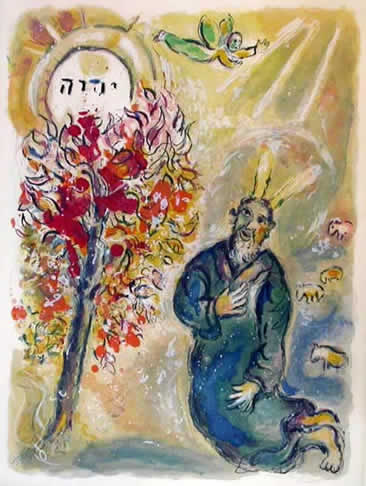
In Exodus Chapter 3, one of the readings for Trinity Sunday, Moses is being called into the ministry from that Burning Bush at the Mountain of God.  He is called into the ministry by a mysterious voice that is both revealing and hiding, comforting and challenging, friendly and intimidating.  The God of Israel who will not be put into a box (though many folks have tried) calls Moses into his service, and much like other folks in Scripture, he doesn't like it.  Not one bit.

Who me?, he says. “If I come to the Israelites and say to them, ‘The God of your ancestors has sent me to you,’ and they ask me, ‘What is his name?’ what shall I say to them?” God responds with a long explication of the divine name: “I AM WHO I AM", adding “Thus you shall say to the Israelites, ‘I AM has sent me to you'. Thus you shall say to the Israelites, ‘The Lord, the God of your ancestors, the God of Abraham, the God of Isaac, and the God of Jacob, has sent me to you’: This is my name forever, and this my title for all generations'."

In celebrating God as Father, Son and Holy Spirit, we use three separate names for the one God -- not only on Trinity Sunday. The Old Testament uses at least seven names for God, and each is based on God's deeds. When God judges his creatures, he is called Elokim. When he wages war on the wicked, he is called Tzevakot. When he tolerates humankind's sins, he is called El-Shadai. When he has compassion on the world, he is called Ha-Va-Yah. Similarly, we Christians attribute certain deeds to the three persons: the Father creates, the Son redeems and the Spirit sustains.

But ... the name under which God reveals himself at the Burning Bush is completely different. This name of God is not about what God does, but who God is. What our translation renders as “I AM WHO I AM” is a rough translation of the Hebrew eh-he-yeh asher eh-he-yeh (אהיה אשר אהיה). It also can mean “I WILL BE WHO I WILL BE” or “I WAS WHO I WAS”. This divine name is built on the Hebrew verb “to be” and is related to the divine name used frequently throughout the Old Testament, “Yahweh”. In the Jewish tradition, this special name of God is considered so holy that it is not to be pronounced in prayer or worship. Where our modern translations put the word “Lord” in capital letters, in the Hebrew original it says YHWH.

YHWH -- this new name of God is not about God's deeds, but about God's being. God's answer to Moses' question “What shall I say is your name?” is something like this:

Tell the children of Israel, that my name is eh-he-yeh. Where was I all these years? With you. I am being, I am existence, I am reality. I am in the groan of a beaten slave, in the wail of a bereaved mother, in the spilled blood of a murdered child. I am not in some distant heaven, holy and removed from your existential pain. I am there with you, suffering with you, praying for redemption together with you. If you cannot see Me, it is not because I am lofty and distant; it is because I am so real. I am as close as your next breath. (Chabad.org)
Moses will be able to teach the children of Israel a whole new way of looking at God -- but first of all, this new concept of God is an answer to the questions he has had about his own life. He is a fugitive, having killed an Egyptian while defending one of his fellow Israelites. He had been rejected by the Egyptians, but more importantly, by his own people as well.  And so he was making a living by taking care of the sheep for his Midianite father-in-law -- with the feelings of being defeated and being homeless as his close companions day in and day out.

The encounter at the Burning Bush has changed all that.  Once defeated, Moses has a new mission; once homeless, Moses has his home with God. Moses becomes powerful because he surrenders his powers to God. When it comes to our own lives, we can draw power in one of two ways:  by trusting our own power, or by surrendering to the power of God.  I call the first the strength of Pharaoh, and the second the strength of Moses.

On one hand, you can choose the strength of Pharaoh, which is selfish and based on having power over others. It is the strength politicians use; it works because it teaches you to walk over dead bodies to get what you want. This strength stands and falls with the human ego that fuels it.  Pharaoh and his army embody this strength – and when Pharaoh and his glorious army drowned in the Red Sea, the whole world saw that something out there was stronger.

On the other hand, you can choose the strength of Moses, which is selfless and based on sharing power with the universe. It is the strength that comes out of love; it is the strength scorned by the mighty ones in the world, yet the only strength that will last forever. This strength has nothing to do with the human ego; it excludes the ego. Moses embodies this strength, as God offers him this strength in the words, “I will be with you.”

 Salvador Dali: Burning Bush

When Jesus says, “Blessed are the meek”, he means a meek person is one who does not exist as an ego. A person who does not exist as an ego any more cannot be conquered, defeated, or destroyed. Such person has gone beyond. By going beyond the ego, you go beyond death. By going beyond the ego, you go beyond defeat. By going beyond the ego, you go beyond powerlessness. This is a totally different concept of power – the power of Moses.

We are called by the One who remains a mystery, who pulls us out of our little lives into the ocean of his own reality. Elizabeth Barrett Browning reminds us that God still calls from the various burning bushes of this world:

Earth’s crammed with heaven, 
And every common bush afire with God; 
But only he who sees, takes off his shoes, 
The rest sit round it and pluck blackberries.

Have you seen a blazing bush lately? Chances are that you have, if not literally than in some other way. God is always out there calling us into service. The question is whether you let it stop you from whatever else you were doing. The question is whether you want to keep on eating blackberries, or whether you will take off your shoes and listen to God. I give thanks for the blazing bushes that force us to find our selves, our journeys, and the mystery we refer to as God.

When Blazing Blackberry Bushes beckon, it's up to you to hear the call.

Exodus 3 

06 June 2011

Of Disciples and Caterpillars


"Lord, is this the time when you will restore the kingdom to Israel?" Clearly, the disciples are stuck in their own small world. Looking backwards, they long for the return of the "good old days", much like some church members demand of us pastors that we bring back the days "when there were hundreds of children in Sunday School".

Jesus responds by re-directing their expectations and expanding their horizons: "It is not for you to know the times or periods that the Father has set by his own authority. But you will receive power when the Holy Spirit has come upon you; and you will be my witnesses in Jerusalem, in all Judea and Samaria, and to the ends of the earth." And with that, he ascends to heaven. 

If Pentecost hadn't happened soon after this, the disciples might have fallen for a fear monger like infamous Mr. Camping (whose doomsday prediction for May 21 didn't pan out). It isn't easy when you are told that looking backwards is not going to help you, and it's harder still when there is no certainty. "It is not for you to know", says Jesus, "but you will receive power when the Holy Spirit has come upon you". When we are told of new horizons and no certainty (at least not the sort we want), we are being called to a journey of faith, but fear will be hovering just around the corner.  "Cast all your anxiety on him, because he cares for you", says the writer of First Peter, but sometimes hanging on to what we know seems so much more comforting.

Change is hard. That is the theme of G. Eustace Owen's poem "The Butterfly", in which a beautiful butterfly comes upon a crying caterpillar. Asked what happened to him, the caterpillar wails about being robbed of his brother.


As they talk, the butterfly tells the caterpillar, "It's me, your brother", explaining to the caterpillar that his brother wasn't lost, but has been transformed into a new life. The caterpillar responds with bitter scorn and accuses his butterfly brother of trying to make fun of him.  It's not like the butterfly doesn't try -- much fo the poem is spent with his loving attempt to get through to his brother -- but the poem ends when the butterfly realizes that all the love and care he brings to his brother are to no avail:

The butterfly gave up the struggle. ‘I have,’ he said, ‘no more to say.’
He spread his splendid wings and ascended Into the air and flew away.
And while he fluttered far and wide, The caterpillar sat and cried.

The caterpillar doesn't understand of what his brother talks. He doesn't believe. He prefers to close himself to the possibility of another life.  Seeing his brother ascend into the air, he grumbles that he is too smart to believe in fairy tales.  So it is with the disciples before Jesus yanks them away from their fear, and so it is with many others who have trouble with change.

How can a caterpillar trust a butterfly? The caterpillar only knows his own experience. He lives in a totally different dimension, on a different plane, in a separate reality. How can a caterpillar believe that some day he will fly into the skies? He only knows crawling on the ground. He is encaged in his shell, he knows nothing about his possible wings. He knows nothing about his potentiality.

When Jesus said, "I am the son of God", people became very angry - caterpillars angry at the butterfly; and the caterpillars gathered together, and they killed the butterfly.  Extraordinary courage is necessary to consider that there is something beyond that which we can understand and control, and that this "other" actually can change our lives to the better.  Extraordinary courage is necessary for people to change, for society has fed our egos and our minds so well that we are programmed to stick to what we know.

How about you? Will you shut yourself up because you prefer a safe life in perfect misery?  Or will you consider the possibility that indeed you too could be ascending into a new life?  Will you choose to hang on to what you know, always looking back and wailing about what you have lost?  Or will you let Jesus wake you up?

Fear or Faith, the choice is yours.

Acts 1: 6-14

30 January 2011

Being the "Poor in Spirit": Being God's Fools

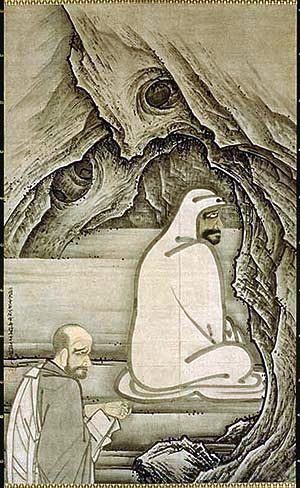
Bodhidharma was a Buddhist monk who lived during the 5th/6th century and is traditionally credited as the transmitter of Zen from India to China.  After he had arrived in China, for nine years he remained in a cave, meditating while facing the wall. Many came to persuade him to come out, ”Why don’t you talk to us? We ask questions and you give answers to the wall. It makes us uncomfortable.” But Bodhidharma said, ”Unless the man comes who has the ears and the heart to understand me, it is better to talk to the wall. At least no one is disappointed.” And then, one day the man came.

This man was a young man named Eka, who had traveled across the high mountains of eastern China in the cold of December. Eka was standing in waist deep snow outside of Bodhidharma's cave, cold tears freezing as they were running down his face. Inside the cave, Bodhidharma was in deep meditation.  

As he waited outside, despite the hardship, despite the suffering, Eka began looking within himself and began to let go off all aspirations and attachments. He simply waited outside for Bodhidharma to recognize him, not for his own sake or for any gain, but because he knew it was right somehow. But Bodhidharma ignored Eka, and stayed inside. Eka strengthened his resolve; he let go of all ambitions and all his ego attachments. 

Finally, at dawn, when the long cold night finally ended, the teacher emerged from the cave, seeing that his new student had indeed progressed quite nicely. Bodhidharma took pity on Eka and asked,“What are you after, standing there in the snow for such a long time?” Eka's tears of sorrow were falling even more profusely as he answered, “I simply ask that you have compassion on me and open the gate to what I long to learn.” 

Bodhidharma said, “That gate can only be opened for those who ceaselessly practice what is hard to practice and who ceaselessly endure what seems beyond endurance. But be warned, if you still rely upon a frivolous heart or on a prideful and conceited mind, you will toil in vain.” 

Eka was encouraged by Bodhidharma's words, but he knew he had to make one more demonstration to prove his worthiness to the Master. So Eka secretly took out a very sharp sword and with one quick stroke, cut off his left forearm. He took his left arm and threw it before Bodhidharma and said, ”If you don’t turn immediately towards me, I am going to cut off my head too.” 


Bodhidharma quickly turned, and said, ”So you have come! I have been waiting for nine years.” Bodhidharma added, "In their seeking the Way, all the masters, from the first, have laid down their own bodies for the sake of the Way. Now you have cut yourself free right before me, which is proof that there is good in what you are seeking.”

For the next eight years, Eka served as attendant to the Master in all his endeavors. He was a great, reliable spiritual friend for both ordinary people as well as for those in loftier positions, and he was a great teacher of the Way. And when the time came, Bodhidharma chose him as his successor.

Eka was inspired by Bodhidharma's words to arouse wisdom and finally cut himself free from any last vestiges of clinging and grasping, represented by his left forearm, and he then presented himself and his understanding to Bodhidharma for approval. The ancient masters maintain that when Eka cut off his arm, there was no effort involved; he was so relaxed, so trustful. He was relaxed and trusting because he had learned to let go. His ego was firmly in check.

The story of Bodhidharma and Eka is about letting go – and so is Jesus' First Beatitude (in today's Gospel text from Matthew 5):

Blessed are the poor in spirit, for theirs is the kingdom of heaven. (Matthew 5:3)

When Johannes Jessen translated that sentence into the Lower German dialect of my home in Northern Germany, he rendered it this way:

Selig sünd de Minschen, de as beddelarme Lüd vör Godd sin Dör kamt un weet, dat se vör em niks uptowiesen hebbt -- ehr hört dat Himmelriek to!  (In plain English: Blessed are those who come to God's door as people who are dirt poor and know they have nothing to show for themselves -- the Kingdom of Heaven is theirs.)

German mystic Meister Eckhart offers this interpretation: “A poor man is one who wants nothing, knows nothing and has nothing.”

  • Eckhart says we need to be “poor of will”, by wanting just as little now as when we were too small and immature to have our current desires. 
  • Eckhart says we need to be “poor of knowledge”, by freeing ourselves from all the knowledge that has been stuffed into us, and by realizing that such knowledge only ties us to this street theater called "the world". 
  • Eckhart says we need to be “poor of having”, by freeing ourselves of all desire to control things with the things we own or cling to. He traces this thought even into our image of God, saying, “I pray to God to make me free of my ideas of God.” If we have ideas of God, we still retain control, and as truly detached believers we must surrender all control.
When we truly are in that place where we want nothing, know nothing and have nothing, we will be free and blessed as on our first day on this planet.

How can we achieve such freedom? Echoing the warning Bodhidharma had for his young student ("If you rely upon a frivolous heart or on a prideful and conceited mind, you will toil in vain"), Eckhart tells us to start the process of putting our ego in check in a very simple manner: “Take a look at yourself, and wherever you find yourself, deny yourself. That is best of all.”

Martin Luther, a theological giant of great fame and vast influence, said these words on his death bed: “We are beggars – this is true.” That's being “poor in the spirit” -- knowing that we come to God as people who have nothing to show for ourselves. And there's nothing wrong with that -- in fact, it's the only way to be right, for "without poverty of spirit, there can be no abundance of God" (Oscar Romero, martyred Archbishop of El Salvador).

What is the result of such freedom? In embodying "a true spirit of poverty which makes the rich feel that they are closer brothers and sisters of the poor, and makes the poor feel that they are equal givers and not inferior" (Oscar Romero), the People of God find themselves in an acute clash with the values of the world, exposing themselves as foolish misfits and outcasts, as "God's fools".  Paul is very sober and clear-eyed when he says:

For the message about the cross is foolishness to those who are perishing, but to us who are being saved it is the power of God. For it is written, "I will destroy the wisdom of the wise, and the discernment of the discerning I will thwart." Where is the one who is wise? Where is the scribe? Where is the debater of this age? Has not God made foolish the wisdom of the world? For since, in the wisdom of God, the world did not know God through wisdom, God decided, through the foolishness of our proclamation, to save those who believe. 

As people who live by the Wisdom of God rather than under the Wisdom of the World, we know that our values do not conform to those of competition and domination that are propagated by the world around us. As the People of God we are truly "countercultural". Our culture teaches us to be selfish, but the cross beckons us to have compassion. Our culture condemns the poor and homeless and blames them for their misfortune, but the cross beckons us to embrace them as sisters and brothers. Our culture teaches us to look down on those who have less, but the cross beckons us to feed them.

Being countercultural carries the very real risk of suffering and the cross, but the rewards are manifold, and far from just otherworldly: as the People of God we can tap into what Rabbi Michael Lerner calls the "irrepressible elements of human nature" shared by all humanity; in his recent article on the "State of the Spirit", Lerner says:

Human beings share a deep yearning to live in communities that provide a sense of purpose to their lives. Yearning to transcend the narrow visions of material self-interest, we long to connect to something of abiding value. We share a hard-wired empathy and love for others, as well as a deep need to be recognized, understood and loved not for what we can do or deliver for others, but for our own intrinsic worth (what the Torah calls being created in the image of God). And we have an irrepressible instinct to seek freedom; creativity; artistic expression; higher and higher levels of understanding and consciousness; love and caring for others; the creation and enjoyment of beauty and pleasure; and both joyous celebration of and awe-filled responses to all the wonders of life in this universe.  

Matthew 5:3; 1 Corinthians 1:18-31