Total Pageviews

Showing posts with label Sermon on the Mount. Show all posts

24 February 2011

A Cure for Worrying: Commemorating Sr. Elizabeth Fedde

On February 25, Lutherans commemorate Elizabeth Fedde (1850-1921), a Norwegian deaconness who, at age 33, followed her brother's urging to come to New York City. At his request, she took up "the work among the poor and lost Norwegians”, but rather than confining herself to visit the ill and poor in their homes, she found herself working in hospitals, on ships and in the streets.

Three years later she asked the newly founded Norwegian Relief Society to start a deaconness home and hospital. Sr. Elizabeth became well-known, and after enlisting businessmen such as Charles Vanderbilt and John D. Rockefeller, a thirty-bed hospital at Fourth Avenue and 46th Street was dedicated in 1889. Soon the Norwegian Relief Society re-incorporated as the Norwegian Lutheran Deaconesses’ Home and Hospital. Then, in April 1892, the first two deaconesses were consecrated in Brooklyn.

But besides being the "mover and shaker" in ever wider circles, Sr. Elizabeth remained dedicated to her work with the sick and the poor. Even though there was some financial support, she was a pioneer. Lack of sleep, being "on call" at all times and the many sick people she worked with -- all this took its toll on her, and she fell ill more and more frequently.

Her ill health made it necessary for Sr. Elizabeth to return to Norway in 1895, but her work lived on, and mightily so. When in 1956 Lutheran Norwegian Deaconess Home and Hospital merged with Lutheran Hospital of Manhattan, the result was Brooklyn's Lutheran Medical Center, which proudly honors Sr. Elizabeth as its founder.


I could write about Sr. Elizabeth because I am the child of a former deaconness. I could write about her because my first couple of years of chaplaincy training took place at Lutheran Medical Center. Or I could write about her because the first church I attended in the United States was on the very spot where Sr. Elizabeth's first hospital stood: 46th and 4th in Sunset Park. Even though those are all good reasons, today I want to write about her faith and her courage, and especially about her ability to trust God.

This is from Sr. Elizabeth's diary:

March 21: Should stay in and sew but was taken to a poor family; quite young people who have been without work so long that they had no money. Mrs. Børs’s $5 was a welcome gift, even though it brought tears; I asked the woman to come Monday to get clothes for the baby who will arrive shortly; I have nothing now, but because I need it, I believe something will come. March 22: Home for housework, and a woman came with a parcel of children’s clothes and asked if I had use for them. I knew I would have them in time for Monday. At meeting in the evening to get help for the poor... 

"I have nothing now, but because I need it, I believe something will come" -- that's putting into action what Jesus says in Sunday's Gospel: "If God so clothes the grass of the field, which is alive today and tomorrow is thrown into the oven, will he not much more clothe you -- you of little faith."

Sr. Elizabeth is not a woman of little faith, not by far, and somehow people around her begin to have a sense that God's love radiates from her.

Here's what she writes one cold January night:

Out in dreadfully cold weather to a poor family down in a cellar, and after talking to them awhile gave them what I had in my pocket because I thought my purse contained carfare; when I looked, I found nothing and I set out on foot late and in bad weather, but God can soften all hearts. A streetcar driver called and said, “Get on!” I said, “I have no money,” and he cried, “Just come!” That sort of thing has never happened to me before.

Her faithfulness shines especially with those who are skeptical. After describing the cyncial attitude of an unemployed and debilitated young man from Norway, she says, "We stood and talked long together. He stood his ground, but when I said that I prayed God every day that He would send me to those He wanted me to see and that I was sure that God had arranged the meeting with him, tears ran down his cheeks, and they said more than words."

Every so often Sr. Elizabeth admits to be "in a very bad humor". One of those times, she is quite frank in describing the effects of a board meeting on her (some of us have been there and felt similar!): "God be merciful! I have the whole board against me and everything is wrong and I wish I were dead. God be merciful to me, a sinner!"  

Yet some time later, her diary says this: "Tired from the day's work, I sit now and wish I had a thousand mouths and a thousand tongues in each mouth with which to praise God for all goodness to me."

Here is part of Sunday's Gospel in the "Cotton Patch Version" by Clarence Jordan:

So cut out your anxious talk about ‘what are we gonna eat, and what are we gonna drink, and what are we gonna wear.’ For the people of the world go tearing around after all these things. Listen, your spiritual Father is quite aware that you’ve got to have all such stuff. Then set your heart on the God Movement and its kind of life, and all these things will come as a matter of course. 


Sr. Elizabeth had her priorities right. Because her heart was set on God and God's kind of life, "all these things" people worry about, they came to her as a matter of course. She believed and thus she received. She remained in God's love, and God's love radiated out of her for all to see. May her faith embolden ours; may it help us navigate the world in new, more trusting, ways!

When everybody else worries his or her head off, it's our business to stay still. We will receive what we need, without fail.

Matthew 6:25-33

12 February 2011

No more Rotten Potatoes!

In tomorrow's Gospel Jesus intensifies and radicalizes Old Testament law, by taking up four of the more contentious issues of his day -- anger, adultery, divorce and swearing. The common motif is how we treat broken relationships as the People of the Kingdom.

Four times Jesus begins with "You have heard" and continues with "But I say". Four times Jesus shows that God's law is about God's love.

He enables his disciples to see the world with the eyes of God, and to be transformed in the process. Charles H. Talbert of Baylor University observes:

To see differently is to have our perceptions altered. From that come changes in our dispositions, intentions and motivations. The Beatitudes and antitheses shape character by enabling a new way of seeing God's will.

Until just a few years ago, every time I returned from visiting my parents, I was such an emotional mess that nobody wanted to be around me. Visiting my folks made me come home with anger and resentment and sadness, ... but no more, for one fine day a friend gave me the story of the sage and his disciple, a story that indeed transformed me by helping me see.
Once there was a sage who asked his disciple to carve out names of the people he could not forgive on potatoes, one potato for each name.
Then, the disciple was asked to put all the potatoes in a sack and carry it with him at all times, for one week.
The longer time went by, the heavier the potatoes seemed to have become. To make the matter worse, those carved potatoes also started to rot and smell bad. It was such an unpleasant experience for the disciple.
At the end of the week, the master asked, "So, what did you learn?" 
The disciple told the master that he now realized that holding on to grudges only brought negative things to him. Asked how he should go about correcting that, the youngster said he should strive his best to forgive everyone that used to cross him and made him angry. 


The master then asked, "What if someone crosses you again after you unload this present load of potatoes?"
The disciple suddenly felt terrified at the thought of having to start all over again with new potatoes, week after week. He said, "What can I do if there are still other people crossing me? I cannot control what other people do to me!"
At which point the master replied, "So far we only discussed the conventional way to approach forgiveness, that is, to strive to forgive. But striving is difficult. It is also quite unneccessary."
Seeing the disciple completely at a loss then, the master asked, "If resentment and anger are the potatoes, what is the sack?"
The disciple finally grasped it, "Ahh the sack is something that allows me to hold on to the negativity. It is my inflated sense of self-importance!"
The master said, "Once you learn to let go of the sack, whatever people say or do against you will no longer matter. Forgiveness is your conscious decision to get rid of the sack altogether, not just the potatoes. Get rid of your self, and your resentment will be gone."

Angry, resentful and sad, I read the story of the sage and his disciple. I cried a bit and read it again, that day and the next few days. And then I got it. It dawned on me that in my navel-gazing and my constant saying "woe is me" I had been in the way of these relationships. All I had been willing to see was my inflated ego and its constant yelling "Me-me-me".

Little by little I learned to get rid of the sack. Every time my best friend heard me returning to the old broken record of my resentment, he said, "So you put that sack on your back again, did you?"  My relationships with my family have changed, and much to the better.

"To love", says Juris Rubens, Latvian Lutheran pastor, "is to want another person to acknowledge that it was worth creating you." Forgiving my folks made it possible for me to love them again. And in doing so, I acknowledged that they were created by God with the same exquisite love and care as everything and everyone else.

The Sufi mystic Rumi -- often reduced to a new-age "poet of love" -- conceives of every expression of human love as an echo of our relationship with the divine lover:

Both light and shadow
are the dance of Love.
Love has no cause;
it is the astrolabe of God’s secrets.
Lover and Loving are inseparable
and timeless.

Although I may try to describe Love
when I experience it I am speechless.
Although I may try to write about Love
I am rendered helpless;
my pen breaks and the paper slips away
at the ineffable place
where Lover, Loving and Loved are one.

Every moment is made glorious
by the light of Love.

"Where Lover, Loving and Loved are one" -- if someone were to look for a hermeneutical key for the Sermon on the Mount, this would be a good start!


Matthew 5:21-37

06 February 2011

Salt and Light in Tahrir Square

When the press tells us that "shoulder-to-shoulder with their Muslim compatriots, Egypt's minority Coptic Christians are flocking to Cairo's central Tahrir Square to join the call for the swift resignation of President Mubarak", it is no surprise to me that Christians are right in the middle of the fray...


...for what they do is in keeping with what Jesus tells his audience in our Gospel text from Matthew Chapter 5:

“You are the salt of the earth; but if salt has lost its taste, how can its saltiness be restored? It is no longer good for anything, but is thrown out and trampled under foot." “You are the light of the world. A city built on a hill cannot be hid. No one after lighting a lamp puts it under the bushel basket, but on the lampstand, and it gives light to all in the house. In the same way, let your light shine before others, so that they may see your good works and give glory to your Father in heaven. (Matthew 5:13-16)

When Jesus says, “You are the salt of the earth” and “You are the light of the world”, he blesses us, he commends us, he affirms us, and he commissions us.

In other words, he tells us who we are.

The Kingdom of God is about this world, and about our life and witness in the world, and so are we. We belong into the middle of this gritty world, for it needs us.

SALT. Salt is important in today's English language: when we mean to say that someone is good, we sometimes say she or he is “worth their salt”, and our word “salary” is derived from the Latin word for salt, since Roman soldiers were paid their wages in salt.

In the ancient world – the world in which Jesus preached the Sermon on the Mount – salt had a much wider number of uses (and thus, meanings). Like in our world, salt was used to purify, preserve and flavor things. But for Jesus and his disciples the word “salt” meant so much more: a symbol for God's covenant, a metaphor for wisdom, and (this one was new to me), a binding agent for fuel paddies made of animal manure: when the fuel paddies were lit in the oven, the mixed-in salt would make them burn longer.

Jesus says that we, the People of God, are the people who purify, preserve and flavor the world around us. We represent God's covenant with humanity. We stand for God's wisdom. And we are here to keep the fire of faith alive even when things get tough.

In 1936, when the Nazi Regime tried to bring all churches under their rule, Pastor Martin Niemöller preached on our text and warned against those in the world who are trying to convince us Christians that we should be more subtle and less loud with our message, that we should compromise more and that we should mold our message to what people want to hear. This is what Pastor Niemöller said in his sermon:

It is precisely when we bring the salt into accord and harmony with the world that we make it impossible for the Lord Jesus Christ, through His Church, to do anything in our nation. Only if the salt remains salt, ... He will use it in such a way that it becomes a blessing.

Martin Niemöller


LIGHT. Our Old Testament lesson this morning makes a clear connection between the works of the People of God and their light:

Is not this the fast that I choose: to loose the bonds of injustice, to undo the thongs of the yoke, to let the oppressed go free, and to break every yoke? Is it not to share your bread with the hungry, and bring the homeless poor into your house; when you see the naked, to cover them, and not to hide yourself from your own kin? Then your light shall break forth like the dawn ... (Isaiah 58:6-8a)

Jesus says we are to shine so that others may see our good deeds and praise God. Niemöller continued: “We are not to worry whether the light is extinguished or not; that is His concern: we are only to see that the light is not hidden away - hidden away perhaps with a noble intent, so that we may bring it out again in calmer times - no: "Let your light shine before men!"”

After the war, Martin Niemöller wrote words that many of us have read or heard:

In Germany they first came for the Communists, and I didn't speak up because I wasn't a Communist. Then they came for the Jews, and I didn't speak up because I wasn't a Jew. Then they came for the trade unionists, and I didn't speak up because I wasn't a trade unionist. Then they came for the Catholics, and I didn't speak up because I was a Protestant. Then they came for me - and by that time no one was left to speak up.

We have no business standing by when injustice happens to someone else. Just because the injustice doesn't extend to us at the moment doesn't mean that we haven't been harmed already. When one human being experiences injustice, we all do.

Thus, I am glad to see that Christians are in the middle of the fray in Tahrir Square in Cairo.

Matthew 5:13-20; 1 Corinthians 2:1-12

30 January 2011

Being the "Poor in Spirit": Being God's Fools

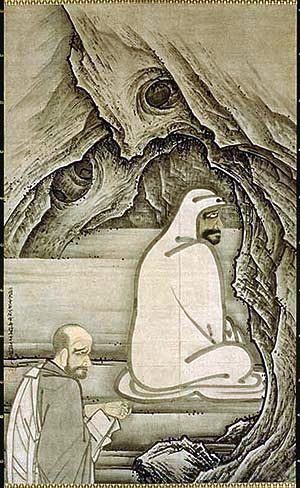
Bodhidharma was a Buddhist monk who lived during the 5th/6th century and is traditionally credited as the transmitter of Zen from India to China.  After he had arrived in China, for nine years he remained in a cave, meditating while facing the wall. Many came to persuade him to come out, ”Why don’t you talk to us? We ask questions and you give answers to the wall. It makes us uncomfortable.” But Bodhidharma said, ”Unless the man comes who has the ears and the heart to understand me, it is better to talk to the wall. At least no one is disappointed.” And then, one day the man came.

This man was a young man named Eka, who had traveled across the high mountains of eastern China in the cold of December. Eka was standing in waist deep snow outside of Bodhidharma's cave, cold tears freezing as they were running down his face. Inside the cave, Bodhidharma was in deep meditation.  

As he waited outside, despite the hardship, despite the suffering, Eka began looking within himself and began to let go off all aspirations and attachments. He simply waited outside for Bodhidharma to recognize him, not for his own sake or for any gain, but because he knew it was right somehow. But Bodhidharma ignored Eka, and stayed inside. Eka strengthened his resolve; he let go of all ambitions and all his ego attachments. 

Finally, at dawn, when the long cold night finally ended, the teacher emerged from the cave, seeing that his new student had indeed progressed quite nicely. Bodhidharma took pity on Eka and asked,“What are you after, standing there in the snow for such a long time?” Eka's tears of sorrow were falling even more profusely as he answered, “I simply ask that you have compassion on me and open the gate to what I long to learn.” 

Bodhidharma said, “That gate can only be opened for those who ceaselessly practice what is hard to practice and who ceaselessly endure what seems beyond endurance. But be warned, if you still rely upon a frivolous heart or on a prideful and conceited mind, you will toil in vain.” 

Eka was encouraged by Bodhidharma's words, but he knew he had to make one more demonstration to prove his worthiness to the Master. So Eka secretly took out a very sharp sword and with one quick stroke, cut off his left forearm. He took his left arm and threw it before Bodhidharma and said, ”If you don’t turn immediately towards me, I am going to cut off my head too.” 


Bodhidharma quickly turned, and said, ”So you have come! I have been waiting for nine years.” Bodhidharma added, "In their seeking the Way, all the masters, from the first, have laid down their own bodies for the sake of the Way. Now you have cut yourself free right before me, which is proof that there is good in what you are seeking.”

For the next eight years, Eka served as attendant to the Master in all his endeavors. He was a great, reliable spiritual friend for both ordinary people as well as for those in loftier positions, and he was a great teacher of the Way. And when the time came, Bodhidharma chose him as his successor.

Eka was inspired by Bodhidharma's words to arouse wisdom and finally cut himself free from any last vestiges of clinging and grasping, represented by his left forearm, and he then presented himself and his understanding to Bodhidharma for approval. The ancient masters maintain that when Eka cut off his arm, there was no effort involved; he was so relaxed, so trustful. He was relaxed and trusting because he had learned to let go. His ego was firmly in check.

The story of Bodhidharma and Eka is about letting go – and so is Jesus' First Beatitude (in today's Gospel text from Matthew 5):

Blessed are the poor in spirit, for theirs is the kingdom of heaven. (Matthew 5:3)

When Johannes Jessen translated that sentence into the Lower German dialect of my home in Northern Germany, he rendered it this way:

Selig sünd de Minschen, de as beddelarme Lüd vör Godd sin Dör kamt un weet, dat se vör em niks uptowiesen hebbt -- ehr hört dat Himmelriek to!  (In plain English: Blessed are those who come to God's door as people who are dirt poor and know they have nothing to show for themselves -- the Kingdom of Heaven is theirs.)

German mystic Meister Eckhart offers this interpretation: “A poor man is one who wants nothing, knows nothing and has nothing.”

  • Eckhart says we need to be “poor of will”, by wanting just as little now as when we were too small and immature to have our current desires. 
  • Eckhart says we need to be “poor of knowledge”, by freeing ourselves from all the knowledge that has been stuffed into us, and by realizing that such knowledge only ties us to this street theater called "the world". 
  • Eckhart says we need to be “poor of having”, by freeing ourselves of all desire to control things with the things we own or cling to. He traces this thought even into our image of God, saying, “I pray to God to make me free of my ideas of God.” If we have ideas of God, we still retain control, and as truly detached believers we must surrender all control.
When we truly are in that place where we want nothing, know nothing and have nothing, we will be free and blessed as on our first day on this planet.

How can we achieve such freedom? Echoing the warning Bodhidharma had for his young student ("If you rely upon a frivolous heart or on a prideful and conceited mind, you will toil in vain"), Eckhart tells us to start the process of putting our ego in check in a very simple manner: “Take a look at yourself, and wherever you find yourself, deny yourself. That is best of all.”

Martin Luther, a theological giant of great fame and vast influence, said these words on his death bed: “We are beggars – this is true.” That's being “poor in the spirit” -- knowing that we come to God as people who have nothing to show for ourselves. And there's nothing wrong with that -- in fact, it's the only way to be right, for "without poverty of spirit, there can be no abundance of God" (Oscar Romero, martyred Archbishop of El Salvador).

What is the result of such freedom? In embodying "a true spirit of poverty which makes the rich feel that they are closer brothers and sisters of the poor, and makes the poor feel that they are equal givers and not inferior" (Oscar Romero), the People of God find themselves in an acute clash with the values of the world, exposing themselves as foolish misfits and outcasts, as "God's fools".  Paul is very sober and clear-eyed when he says:

For the message about the cross is foolishness to those who are perishing, but to us who are being saved it is the power of God. For it is written, "I will destroy the wisdom of the wise, and the discernment of the discerning I will thwart." Where is the one who is wise? Where is the scribe? Where is the debater of this age? Has not God made foolish the wisdom of the world? For since, in the wisdom of God, the world did not know God through wisdom, God decided, through the foolishness of our proclamation, to save those who believe. 

As people who live by the Wisdom of God rather than under the Wisdom of the World, we know that our values do not conform to those of competition and domination that are propagated by the world around us. As the People of God we are truly "countercultural". Our culture teaches us to be selfish, but the cross beckons us to have compassion. Our culture condemns the poor and homeless and blames them for their misfortune, but the cross beckons us to embrace them as sisters and brothers. Our culture teaches us to look down on those who have less, but the cross beckons us to feed them.

Being countercultural carries the very real risk of suffering and the cross, but the rewards are manifold, and far from just otherworldly: as the People of God we can tap into what Rabbi Michael Lerner calls the "irrepressible elements of human nature" shared by all humanity; in his recent article on the "State of the Spirit", Lerner says:

Human beings share a deep yearning to live in communities that provide a sense of purpose to their lives. Yearning to transcend the narrow visions of material self-interest, we long to connect to something of abiding value. We share a hard-wired empathy and love for others, as well as a deep need to be recognized, understood and loved not for what we can do or deliver for others, but for our own intrinsic worth (what the Torah calls being created in the image of God). And we have an irrepressible instinct to seek freedom; creativity; artistic expression; higher and higher levels of understanding and consciousness; love and caring for others; the creation and enjoyment of beauty and pleasure; and both joyous celebration of and awe-filled responses to all the wonders of life in this universe.  

Matthew 5:3; 1 Corinthians 1:18-31